
Table of Contents
Yes. If you were injured because someone opened a car door into your path while you were riding a bicycle in Chicago, you may be able to file an injury claim against the person who opened the door, the vehicle owner’s insurance, a rideshare-related policy, a commercial policy, or another available source of coverage.
A dooring crash can look simple from the outside: one car door, one cyclist, one sudden impact. Legally, it is rarely that simple. The claim may involve Illinois traffic law, Chicago bicycle ordinances, comparative fault arguments, auto insurance limits, medical proof, lost wages, bike damage, surveillance footage, and sometimes hit-and-run or rideshare coverage questions.
That is why the first few days after the crash matter. The car moves, the driver changes their story, nearby camera footage gets overwritten, and the insurance company may start framing the cyclist as careless before the injured rider has even finished medical treatment. This guide explains who may be liable, what evidence matters most, how deadlines work, and what compensation may be available after a Chicago bicycle dooring accident.
| Key Takeaways · Yes, you can file a claim after a bicycle dooring accident in Chicago when a driver, passenger, rideshare passenger, or other vehicle occupant opens a door when it is not reasonably safe. · Illinois law and Chicago ordinances both address unsafe door opening. A Chicago dooring violation that causes a bicycle collision can carry a $1,000 fine, and that violation can become powerful evidence in a civil injury claim. · The strongest claims preserve photos, witness names, police reports, medical records, bike repair estimates, helmet damage, app/GPS data, and nearby surveillance footage before it disappears. · Most Illinois personal injury lawsuits must be filed within two years, but insurance notice, government-vehicle claims, and evidence-preservation deadlines may require action much sooner. |
What Is a Bicycle Dooring Accident?
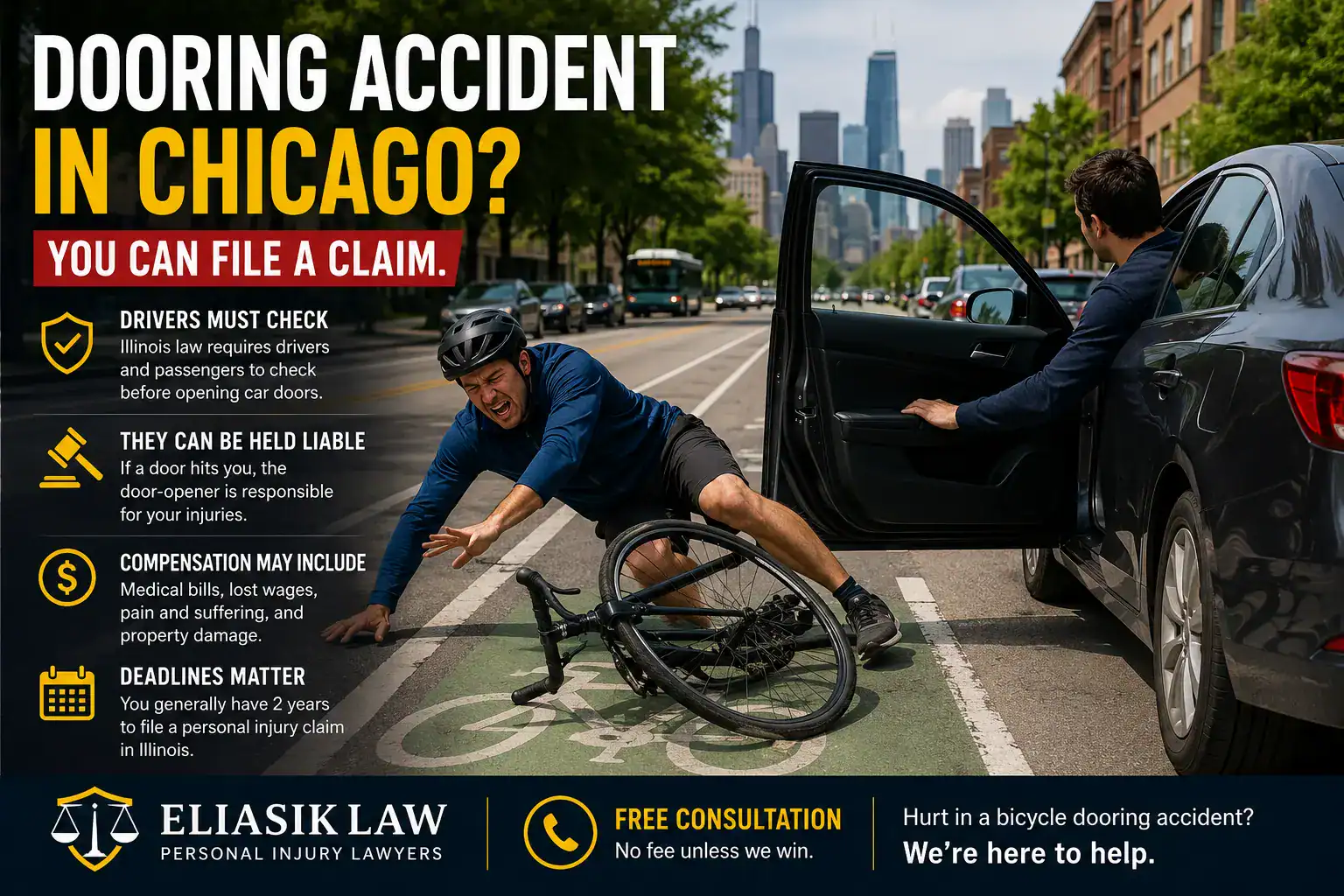
A bicycle dooring accident happens when a driver, passenger, or other vehicle occupant opens a door into the path of a moving cyclist. The cyclist may hit the door directly, swerve into traffic to avoid it, or crash into the pavement while trying to stop.
Dooring crashes are especially dangerous in Chicago because many bike routes run next to parallel parking. On streets such as Milwaukee Avenue, Damen Avenue, Halsted Street, Clark Street, and other high-ridership corridors, cyclists often ride close to parked cars while moving traffic passes on the left. When a door suddenly opens, the rider may have less than a second to react.
The injuries can be serious even at ordinary cycling speeds. Common dooring injuries include collarbone fractures, wrist and hand fractures, shoulder injuries, concussions, dental trauma, road rash, knee injuries, back and neck injuries, and traumatic brain injuries. If the cyclist is pushed into a moving lane and struck by another vehicle, the crash can become catastrophic or fatal.
External authority: Illinois Secretary of State Dutch Reach awareness campaign
What Illinois and Chicago Law Say About Opening Car Doors
Illinois law makes unsafe door opening a traffic-safety issue, not just bad manners. Under the Illinois Vehicle Code, no person may open a vehicle door on the side available to moving traffic until it is reasonably safe and can be done without interfering with other traffic. That includes bicycles traveling beside parked cars.
Chicago has a parallel local rule. Chicago Municipal Code Section 9-80-035 says a person cannot open a vehicle door on the traffic side unless it is reasonably safe and does not interfere with other traffic. Chicago’s bicycle-safety penalty ordinance also makes the consequences clear: a violation that interferes with bicycle movement can carry a $300 fine, and a violation that causes a motor vehicle-bicycle collision can carry a $1,000 fine.
For an injury claim, these rules help establish duty and breach. In plain English, the person opening the door had a duty to check for cyclists and wait until it was safe. If they opened the door into your path, that violation can support the argument that they were negligent.
External authority: 625 ILCS 5/11-1407 – Opening and closing vehicle doors
External authority: Chicago Municipal Code 9-80-035 – Opening and closing vehicle doors
External authority: Chicago Municipal Code 9-4-025 – Bicycle safety violation penalties
Who May Be Liable After a Chicago Dooring Crash?
Liability usually starts with the person who opened the door. That could be the driver, a front-seat passenger, a rear-seat passenger, a rideshare passenger, a taxi passenger, or someone exiting a parked delivery vehicle. The question is whether the person opened the door when it was not reasonably safe and whether that act caused your injury.
| Possible Party | Why They May Matter | Evidence to Preserve |
| Driver or passenger | The person who opened the door may be directly responsible for failing to check before opening it. | Names, license plate, insurance card, police report, witness statements. |
| Vehicle owner | Coverage may depend on the owner’s policy, permission to use the vehicle, and who was occupying it. | Registration, insurance policy, driver relationship to owner. |
| Rideshare or taxi involvement | Uber, Lyft, taxi, or livery situations may involve additional policy and trip-status questions. | App screenshots, trip receipt, driver info, passenger info, pickup/drop-off location. |
| Commercial vehicle or employer | If the door was opened from a work vehicle, delivery vehicle, or company car, employer/commercial coverage may apply. | Company name, DOT number if present, employer information, photos of vehicle markings. |
| Government vehicle | If the vehicle belonged to the City, CTA, park district, or another public entity, special deadlines and defenses may apply. | Vehicle number, agency name, incident report, prompt legal review. |
Do not assume the claim is impossible just because the person who opened the door was not the driver. In many cases, the insurance analysis turns on the vehicle involved, the person’s relationship to the vehicle, whether a trip was active, and what policies were in force at the time of the crash.
Can You File a Claim If You Were Not in a Bike Lane?
Yes. A marked bike lane can make liability easier to explain, but it is not required. Illinois law gives bicyclists using the roadway many of the same rights and duties as drivers, and the door-opening rule applies to doors opened into moving traffic. A driver or passenger still must check before opening a door even if the cyclist is riding in a shared lane, passing a blocked bike lane, avoiding potholes, or moving around double-parked vehicles.
That said, the insurance company may argue comparative fault. It may claim you were riding too close to parked cars, moving too fast, weaving, riding without lights at night, or using the sidewalk improperly. Under Illinois modified comparative negligence, a plaintiff is barred only if their fault is more than 50%; if their fault is 50% or less, damages are reduced by that percentage. This makes evidence about your lane position, speed, lighting, and the door opener’s conduct especially important.
External authority: 735 ILCS 5/2-1116 – Illinois modified comparative negligence
What Compensation Can You Recover After a Bicycle Dooring Accident?
A bicycle dooring claim can include the same categories of damages as other Illinois personal injury claims. The value depends on the severity of the injury, the available insurance, the strength of the evidence, and how the crash affects your work and daily life.
- Medical expenses: emergency care, ambulance bills, imaging, surgery, follow-up visits, medication, physical therapy, dental care, orthopedic care, and future treatment.
- Lost wages: missed shifts, unpaid leave, used PTO, reduced hours, missed freelance work, and lost income during recovery.
- Loss of earning capacity: reduced ability to work if the injury causes long-term limits, permanent restrictions, or a career change.
- Property damage: bike repair or replacement, helmet replacement, torn clothing, phone damage, lights, panniers, bike computer, and other gear.
- Pain and suffering: physical pain, emotional distress, anxiety about riding again, loss of enjoyment of cycling, scarring, disability, and disruption to daily activities.
Insurance limits matter. Illinois requires most motorists to carry minimum liability coverage of 25/50/20: $25,000 per person and $50,000 per accident for bodily injury, plus $20,000 for property damage. Serious bicycle injuries can exceed those minimums quickly, especially when surgery, hospitalization, or long-term therapy is involved.
External authority: Illinois Department of Insurance – filing a claim with another driver’s insurer
What If the Driver or Passenger Leaves the Scene?
A hit-and-run dooring accident does not end your claim, but it changes the evidence and coverage strategy. Call 911, report the crash, and preserve any details that may identify the vehicle: license plate digits, make, model, color, rideshare decals, company logos, direction of travel, and nearby cameras.
If the at-fault person cannot be identified or does not have coverage, your own uninsured motorist coverage may become important. Illinois uninsured motorist bodily injury coverage generally applies to injuries caused by a hit-and-run driver or an at-fault driver with no auto liability insurance. Whether it applies to a cyclist depends on the policy language and facts, so the policy should be reviewed carefully before assuming there is no coverage.
If the at-fault driver has some insurance but not enough, underinsured motorist coverage may help fill the gap when your UIM limits are higher than the at-fault driver’s liability limits. This is why injured cyclists should notify their own insurer promptly but avoid giving broad recorded statements before getting legal advice.
External authority: Illinois Department of Insurance – UM/UIM coverage definitions
What Evidence Do You Need to Prove a Bicycle Dooring Claim?
Dooring claims often turn on a simple question: did the person open the door when it was not reasonably safe? The best evidence answers that question from multiple angles: what the street looked like, where the bike was, how the door opened, what injuries happened, and how quickly you sought treatment.
| Evidence | Why It Helps |
| Photos of the open door, vehicle, bike, street, and injuries | Shows the door position, impact area, bike-lane markings, vehicle damage, and the physical consequences of the crash. |
| Police report or incident number | Creates an official record, identifies parties, and may document citations or initial statements. |
| Witness names and phone numbers | Neutral witnesses can confirm that the door opened suddenly or that the cyclist had no time to avoid it. |
| Surveillance, dashcam, helmet-cam, or business video | Video may show the door opening, the cyclist’s lane position, traffic conditions, and whether the vehicle was stopped or unloading. |
| Medical records from the same day or shortly after | Connects the injuries to the dooring crash and reduces insurer arguments about delayed treatment. |
| Bike shop repair estimate and helmet replacement | Documents property damage and helps show impact severity. |
| App, GPS, or trip data | Can support your location, time, speed, route, and whether the crash happened during a rideshare or bike-share trip. |
Nearby video matters because dooring scenes change fast. Parked cars leave, businesses overwrite security footage, and drivers may later describe the door as “only open a little” or claim the cyclist appeared out of nowhere. Preservation letters and fast camera canvassing can make the difference between a disputed claim and a clear liability case.
What Should You Do Immediately After a Bicycle Dooring Accident in Chicago?
- Call 911 if you are hurt, hit the pavement, have head pain, or cannot safely move out of traffic.
- Do not apologize or admit fault. Stay factual: where you were riding, what opened, where you hit, and what hurts.
- Photograph the door, car, bike, helmet, injuries, traffic lane, bike lane, curb, parking signs, and nearby cameras.
- Get the driver’s and door opener’s names, phone numbers, insurance information, license plate, and vehicle owner information.
- Ask witnesses for names and phone numbers before they leave. A quick text from them describing what they saw can help preserve their memory.
- Get medical care the same day or as soon as symptoms appear. Tell the provider exactly how the crash happened: “a parked car door opened into my bike path.”
- Save all medical records, receipts, bike repair estimates, photos, app data, and insurance letters in one folder.
- Speak with a lawyer before giving the at-fault insurer a recorded statement or signing a broad medical release.
How Long Do You Have to File a Bicycle Dooring Claim in Illinois?
Most Illinois personal injury lawsuits must be filed within two years of the injury date. That deadline is important, but it is not the only deadline that matters. Insurance policies may require prompt notice. Video may disappear within days or weeks. Witnesses may be hard to locate after the scene clears. If a city, CTA, park district, state, or other public vehicle is involved, additional rules and shorter procedural deadlines may apply.
Do not treat the two-year statute of limitations as a reason to wait. In a dooring case, the most important evidence is often available only in the first 24 to 72 hours: the parked vehicle, the damage pattern, witness information, camera footage, and fresh medical documentation.
External authority: 735 ILCS 5/13-202 – Illinois personal injury limitations period
How Insurance Companies Try to Defend Bicycle Dooring Claims
Insurance companies often know that dooring law favors cyclists, so they shift the fight to comparative fault, medical causation, and damages. They may argue that you were too close to the parked cars, riding too fast, not in the bike lane, not wearing a helmet, looking down, or failing to brake quickly enough.
They may also minimize the injury: “just road rash,” “just a sprain,” or “no broken bones.” This can be misleading. A wrist injury, shoulder tear, concussion, or neck injury can affect work, sleep, transportation, and daily life for months. If the insurer asks for a quick release before you finish treatment, remember that a release usually ends the claim forever, even if symptoms later worsen.
The best response is documentation. Photos, medical records, repair estimates, wage proof, and witness statements make the claim harder to dismiss. A clear legal narrative also matters: the door opener had a duty, violated that duty, and caused measurable harm.
What If a Rideshare Passenger Opened the Door?
Rideshare dooring cases require careful coverage review. The person who opened the door may be liable, but the available insurance can depend on whether the Uber or Lyft ride was active, where the vehicle stopped, who opened the door, whether the driver stopped illegally or unsafely, and what the rideshare company’s policy says.
Do not assume there is automatically a $1 million policy available for every rideshare-related dooring. Some coverage may apply only during certain trip phases or to certain types of claims. Preserve the app receipt, trip screenshot, driver name, vehicle information, pickup or drop-off location, and any messages in the app. Those details help determine which policies may be triggered.
What If You Were Riding a Divvy or Another Bike-Share Bike?
You can still file a claim against the at-fault driver, passenger, or available insurer if a dooring crash injures you while riding a Divvy or another bike-share bicycle. The fact that you were using a rental bike does not eliminate the door opener’s duty to check for traffic.
Bike-share cases add extra evidence layers. Save the trip record, station location, bike number, app screenshots, route data if available, and photos of any bike defect or damage. If the bike itself contributed to the crash because of brake failure, loose equipment, or another defect, that may require a separate analysis from the dooring claim.
Why Legal Help Matters After a Chicago Dooring Accident
A strong dooring claim is not just about saying, “The door opened.” It is about proving every legal element and anticipating the insurance company’s defenses. That means identifying the correct insurer, preserving video, reviewing policy limits, documenting medical causation, countering comparative fault arguments, and valuing both short-term and long-term losses.
The Law Offices of John S. Eliasik helps injured people in Chicago and across Illinois understand their options after bicycle and traffic-related injuries. John S. Eliasik’s background working for a major insurance company gives the firm practical insight into how adjusters evaluate claims, where they look for weaknesses, and what evidence can move a case toward fair compensation.
Get Help After a Bicycle Dooring Accident in Chicago
If you were hurt because someone opened a car door into your bike path, do not wait for the insurance company to define your claim. Contact The Law Offices of John S. Eliasik for a free case evaluation. The sooner your legal team can review the scene, preserve camera footage, identify coverage, and document your injuries, the stronger your claim may be.
FAQs
Can you file a claim after a bicycle dooring accident in Chicago?
Yes. If a driver, passenger, or other vehicle occupant opened a door when it was not reasonably safe and you were injured, you may have a claim for medical bills, lost wages, bike damage, pain and suffering, and other losses.
Is dooring illegal in Illinois?
Illinois law prohibits opening a vehicle door on the traffic side until it is reasonably safe and can be done without interfering with other traffic. Chicago has a similar local ordinance, and a dooring violation that causes a bicycle collision can carry a $1,000 fine.
Who pays for a bicycle dooring accident in Chicago?
The claim may be paid by the vehicle owner’s auto insurer, the door opener’s available coverage, a commercial policy, a rideshare-related policy, or your own UM/UIM coverage depending on the facts and policy language.
Can you recover if the driver says you were too close to parked cars?
Maybe. Illinois uses modified comparative negligence. If your fault is not more than 50%, you can still recover, but your compensation is reduced by your percentage of fault. Evidence about bike-lane conditions, parked cars, speed, and the open door is important.
Do you need a police report after a Chicago dooring accident?
A police report is strongly helpful. It creates an official record, identifies the parties, and may document citations or witness statements. If an officer does not come to the scene, ask how to file a report as soon as possible.
What if the person who opened the door left the scene?
Report it immediately and preserve identifying details such as license plate digits, vehicle color, make, model, rideshare decals, company logos, and camera locations. Your own uninsured motorist coverage may apply depending on your policy.
Can you file a claim if you were not wearing a helmet?
Yes. Adult cyclists are generally not required to wear helmets in Illinois, but the insurer may argue that a missing helmet contributed to a head injury. The impact depends on the injuries, medical evidence, and comparative fault arguments.
What evidence is most important after a bicycle dooring accident?
Photos of the open door, bike damage, injury, street layout, bike-lane markings, and vehicle position are critical. Also save witness contact information, police report details, medical records, repair estimates, app data, and nearby video footage.
How long do you have to file a bicycle dooring lawsuit in Illinois?
Most Illinois personal injury lawsuits must be filed within two years, but insurance notice and evidence deadlines come much sooner. Claims involving public entities or government vehicles may have additional requirements.
Can you file a claim if you were riding a Divvy bike?
Yes. A bike-share rental does not erase the door opener’s duty to check before opening the door. Save the trip record, bike number, station location, app screenshots, photos, and any evidence showing how the crash happened.
Disclaimer: This article is provided by Eliasik Law for general informational purposes only and does not constitute legal advice. Reading this content does not create an attorney-client relationship. Laws, fees, regulations, and court decisions referenced may change. For advice on your specific situation, please contact Eliasik Law directly to schedule a consultation.