
Table of Contents
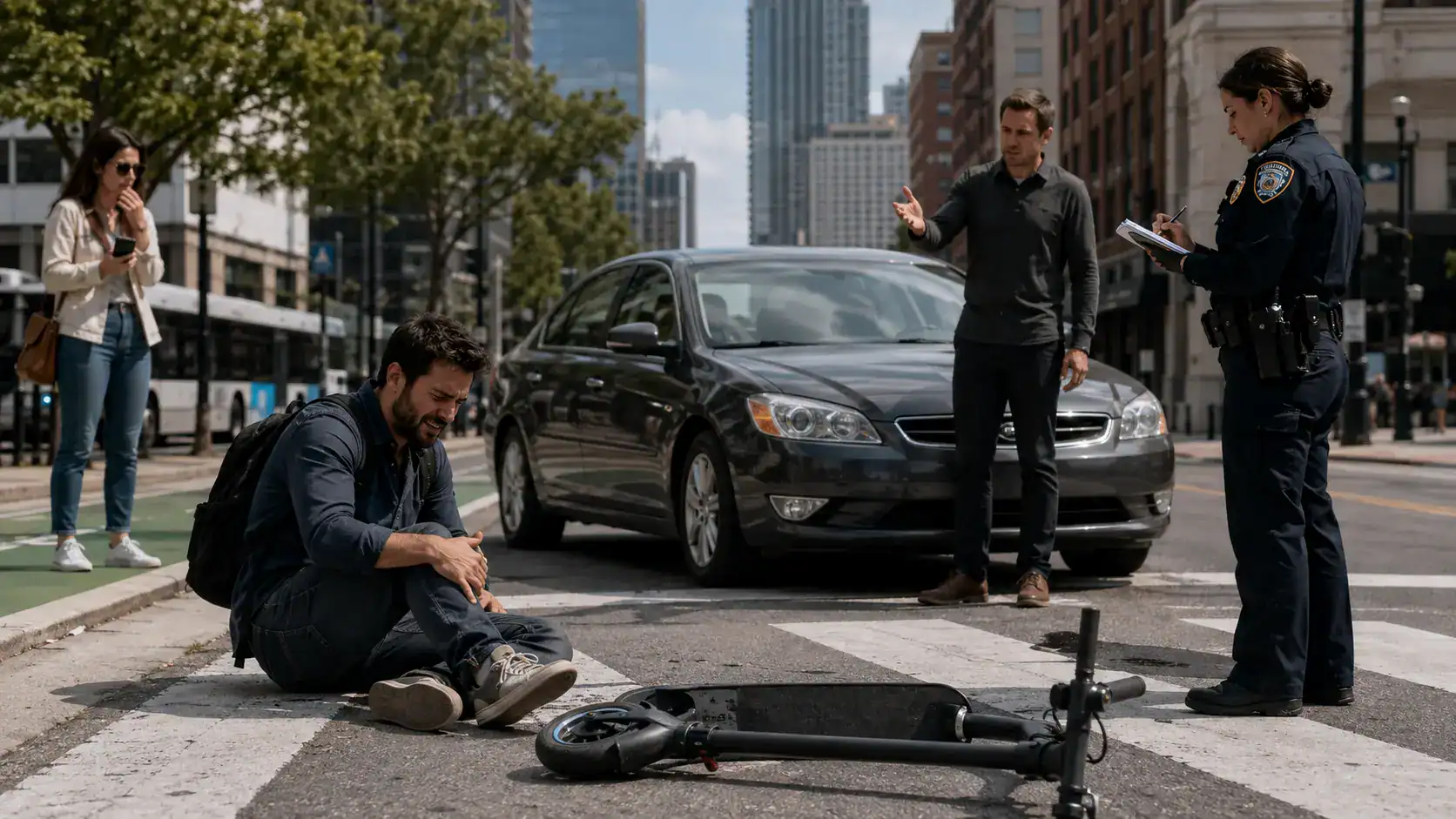
Liability after an e-scooter accident in Chicago depends on how the crash happened, where it happened, and whose conduct caused the injury. A careless scooter rider may be liable if they hit a pedestrian. A driver may be liable if they turned into a bike lane, opened a door without looking, or hit a scooter rider in traffic. A scooter company may be responsible if a rental scooter failed because of poor maintenance, defective brakes, throttle problems, or missing safety warnings. In some cases, a property owner or the City of Chicago may also be part of the claim if a dangerous road, sidewalk, construction zone, or parking condition caused the crash.
These cases are rarely as simple as a normal two-car collision. E-scooters can involve traffic laws, bike-lane rules, product-liability issues, app-based rental agreements, municipal deadlines, and multiple insurance policies. That is exactly why insurers often try to shift blame quickly. They may say the scooter rider was going too fast, the pedestrian stepped out suddenly, the driver never saw the scooter, or the hazard was someone else’s responsibility.
The practical answer is this: the liable party is the person or company whose negligence caused or contributed to the crash. The challenge is proving it before the scooter is repaired, app data disappears, video footage is overwritten, witnesses move on, and insurance adjusters start rewriting the story. This guide explains the most common liability scenarios after an e-scooter accident in Chicago and what evidence can help protect an injury claim.
| Quick Answer Who is liable after an e-scooter accident in Chicago? The liable party may be the e-scooter rider, a motor vehicle driver, the rental scooter company, a property owner, the City of Chicago, or more than one party. Illinois modified comparative negligence allows an injured person to recover if their share of fault is not more than 50%, but the recovery is reduced by their percentage of fault. |
Key Takeaways
- Chicago scooter sharing rules say scooters must generally operate like bicycles and are limited to bike lanes or paths where available, with street use allowed where no bike lane or path exists.
- The e-scooter rider may be liable if they were riding recklessly, riding where prohibited, ignoring traffic controls, speeding for the conditions, carrying a passenger, or riding impaired.
- A driver may be liable if they failed to yield, opened a door into the rider, turned across a bike lane, ran a red light, drove distracted, or failed to check blind spots.
- A scooter company may be liable if poor maintenance, defective parts, weak brakes, software issues, or missing warnings caused the crash.
- A government or property claim can have shorter deadlines than a normal injury case, so pothole, sidewalk, construction, or street-defect cases require fast review.
- Evidence matters early: photos, police reports, witness details, scooter ID numbers, app screenshots, video footage, medical records, and repair or maintenance data can all affect liability.
How Chicago E-Scooter Liability Works
Chicago e-scooter liability starts with one question: who breached a legal duty of care? Every road user has a duty to act reasonably. E-scooter riders must ride carefully and follow applicable traffic rules. Drivers must watch for smaller road users and avoid unsafe turns, dooring, and distracted driving. Scooter companies must avoid putting unsafe rental devices into public use. Property owners must address hazards they know or should know about. Government entities can have duties too, but claims against them are more technical and time-sensitive.
The Chicago Municipal Code treats low-speed electric mobility devices under bicycle-related operating and parking rules, and Chicago scooter sharing rules state that scooters are to be operated the same way bicycles are operated under Section 9-52-130. Those rules also state that shared scooters are permitted only on bike lanes or paths, may not be operated on sidewalks except where the code allows, and may use city streets where no bike lane or path exists. Chicago scooter sharing operational requirements are an important starting point when a crash involves a shared rental scooter.
That does not mean a rider is automatically at fault after every scooter crash. A rider can be following the rules and still be hit by a driver who fails to yield. A pedestrian can be hurt by a rider who ignored sidewalk restrictions. A rider can crash because a rental scooter lost braking power or because a construction plate, pothole, or debris field made the lane unsafe. The facts determine the claim.
Common Liability Scenarios After a Chicago E-Scooter Accident
| Potentially Liable Party | Common Examples | Evidence That Helps |
| E-scooter rider | Riding on a prohibited sidewalk, running a light, riding too fast for foot traffic, weaving, intoxication, or failing to yield. | Witness statements, video footage, police report, app trip data, photos of the route, injuries, and scene. |
| Motor vehicle driver | Turning across a bike lane, dooring, distracted driving, speeding, failing to yield, or hitting a rider in an intersection. | Crash report, citations, vehicle damage, traffic-camera or business video, phone-use evidence, witness statements. |
| Scooter company | Defective brakes, throttle malfunction, software issue, poor maintenance, missing warning, or unsafe deployment. | Scooter ID, QR code, app screenshots, maintenance records, incident report, preserved scooter, expert inspection. |
| Property owner | Hazard on private walkway, parking lot, apartment complex, garage, campus, or business entrance. | Photos of hazard, maintenance logs, prior complaints, lighting records, incident reports, surveillance footage. |
| City or public entity | Potholes, unsafe lane design, missing signs, construction hazards, or public-way defects. | Immediate photos, exact location, prior notice evidence, 311 records, police report, expert inspection, deadline review. |
When the E-Scooter Rider May Be Liable
An e-scooter rider may be liable if their careless riding caused someone else to get hurt. This often comes up when a scooter rider hits a pedestrian, another cyclist, a rideshare passenger stepping out of a vehicle, or another scooter user. The claim usually turns on whether the rider violated a traffic rule or failed to act reasonably under the conditions.
Examples include riding too fast through a crowded area, failing to yield, ignoring a stop sign or red light, riding against traffic, using a phone while riding, carrying a second rider on a device designed for one person, or riding on a sidewalk where the rules do not allow it. Chicago bicycle sidewalk rules allow sidewalk riding only in limited circumstances, such as access to the nearest roadway, intersection, designated bicycle path, or bicycle share station, and Section 9-52-130 applies bicycle operation and parking rules to low-speed electric mobility devices.
If a rider broke a rule and that rule violation caused the crash, the violation can support negligence. But the analysis still depends on facts. A rider may have moved out of a bike lane because a delivery truck blocked it, a pothole made the lane unsafe, or a driver opened a door. That can shift part or all of the fault away from the rider.
When a Motor Vehicle Driver May Be Liable
Drivers are frequently involved in serious e-scooter injuries because a scooter rider has little protection against a car, truck, bus, or rideshare vehicle. A driver can be liable when they fail to watch for scooters in bike lanes, intersections, parking areas, and curbside zones.
Common driver-liability scenarios include left-turn and right-turn conflicts, dooring, distracted driving, failure to yield, sudden lane changes, close passing, speeding, and rear-end collisions. A driver may say the scooter “came out of nowhere,” but that is often a visibility argument, not a defense. Drivers must check mirrors and blind spots, obey signals, yield where required, and avoid opening doors or turning across the path of a lawful rider.
Evidence in driver-liability cases often includes police diagrams, vehicle damage patterns, skid or braking marks, dashcam footage, intersection camera footage, witness statements, and photos showing the lane layout. If the crash happened near a business, gas station, apartment building, CTA stop, or parking garage, surveillance footage may exist for only a short time before it is overwritten.
When the Scooter Company May Be Liable
A scooter company may be liable when the device itself contributed to the crash. Rental e-scooters are not just transportation devices; they are also app-connected products with physical components, software systems, batteries, brakes, throttles, handlebars, tires, lights, bells, and data logs.
Possible company-related claims include weak brakes, brake failure, stuck throttles, sudden loss of power, steering instability, missing reflectors or lights, poor tire condition, battery or charging hazards, poor maintenance schedules, failure to remove unsafe scooters from service, or failure to warn riders about known risks. Chicago scooter sharing rules require licensees to conduct maintenance and keep maintenance records at least once per calendar month, and those records can become important evidence when a malfunction is suspected.
The U.S. Consumer Product Safety Commission has reported that micromobility-related injuries have trended upward since 2017, increasing an estimated average of 23% annually, and it has identified collisions with motor vehicles and control issues as leading hazards. The CPSC also emphasizes checking brakes, throttle, lights, tires, cables, and frame before riding because small wheels and surface defects can make e-scooters unstable. CPSC micromobility injury and safety data can help explain why device condition and maintenance are central in serious scooter cases.
Rental companies often point to app waivers and terms of service. Those agreements should be reviewed carefully, but they do not automatically end every claim. A waiver may not protect a company from gross negligence, defective-product allegations, or facts that fall outside the scope of the waiver. A lawyer can review the user agreement, the maintenance history, and the device data before the company controls the narrative.
When a Property Owner or the City of Chicago May Be Liable
Some scooter crashes happen because the riding surface is unsafe. A pothole, broken pavement, metal construction plate, unmarked hazard, loose gravel, poor lighting, blocked lane, or debris pile can cause a rider to fall or force a rider into traffic. Liability depends on who controlled the area and whether that party knew or should have known about the hazard.
A private property owner may be liable for hazards in a parking lot, apartment complex, campus, loading area, commercial walkway, or private path if they failed to keep the area reasonably safe. A business or contractor may also be liable if it created the hazard. For example, a contractor that leaves debris in a bike lane or a property manager that ignores a broken walkway may become part of the claim.
Claims against the City of Chicago or another public entity are more technical. Under the Illinois Local Governmental and Governmental Employees Tort Immunity Act, most injury actions against a local public entity or employee must be commenced within one year, not the general two-year personal injury deadline. 745 ILCS 10/8-101 is one reason public-way, pothole, construction-zone, and street-maintenance claims should be reviewed quickly.
How Illinois Comparative Negligence Affects E-Scooter Claims
Illinois uses modified comparative negligence. Under 735 ILCS 5/2-1116, an injured person is barred from recovering damages if their contributory fault is more than 50% of the proximate cause of the injury. If their fault is 50% or less, they can still recover, but the award is reduced by their percentage of fault.
For example, if an injured scooter rider has $120,000 in damages and is found 20% at fault for riding too fast for the conditions, the recovery would be reduced by 20%, leaving $96,000 before liens, fees, costs, or other case-specific adjustments. If the same rider were found 51% at fault, they would recover nothing.
That is why blame-shifting happens so quickly in scooter cases. A driver may claim the rider was reckless. A scooter company may claim the rider ignored app instructions. A property owner may claim the hazard was open and obvious. The goal is to push the injured person over the 50% line or reduce the settlement value. Strong evidence is how you push back.
What Evidence Helps Prove Liability After an E-Scooter Accident?
The best evidence depends on the type of crash, but most Chicago e-scooter claims benefit from a full preservation plan. The strongest cases usually document three things: what caused the crash, how the injuries happened, and what losses followed.
- Scene photos and videos: the scooter, vehicle damage, sidewalk or road condition, traffic controls, bike-lane markings, debris, lighting, skid marks, and final resting positions.
- Scooter identifiers: QR code, device number, license plate or company label, app screenshots, trip start and end times, battery status, and rental receipt.
- Police report and incident reports: reports to CPD, the scooter company, a business owner, property manager, security guard, or rideshare platform.
- Witness information: names, phone numbers, emails, short written statements, and bystander video.
- Digital evidence: app data, GPS route, speed data, braking logs, traffic cameras, dashcams, business surveillance, phone records, and 911 call records.
- Medical proof: ER records, urgent-care notes, imaging, physical therapy records, prescriptions, work restrictions, and follow-up visits.
- Wage and financial proof: pay stubs, employer letters, invoices, missed shifts, gig-work records, bike or scooter repair costs, and out-of-pocket expenses.
Do not wait to gather this evidence. The scooter may be repaired or redeployed, business surveillance may be erased, witnesses may be impossible to find, and app data may sit in systems controlled by the company you may need to pursue.
Who Pays Medical Bills and Lost Wages After an E-Scooter Accident?
The liable party and the paying source are not always the same thing at the beginning of a case. Medical bills often arrive before liability is resolved. Health insurance, medical payments coverage, personal auto insurance, a driver’s liability insurance, scooter-company insurance, property insurance, or a later settlement may all be involved depending on the facts.
If a driver hit you while you were on a scooter, the driver’s bodily-injury liability coverage may be the main recovery source. If the driver fled or lacked enough insurance, your own uninsured or underinsured motorist coverage may need to be reviewed. Many UM/UIM policies protect insureds as pedestrians or cyclists, but scooter coverage is policy-specific and should not be assumed without reading the policy language.
If a scooter rider hit you as a pedestrian, coverage may be more complicated. The rider may have renters or homeowners liability coverage, but many policies exclude motorized devices. If a rental scooter malfunctioned, the scooter company’s commercial or product-liability coverage may be relevant. If a property hazard caused the crash, a premises-liability policy may apply. A thorough claim review looks for every possible coverage source instead of stopping at the first denial.
How Long Do You Have to File an E-Scooter Accident Claim in Illinois?
For most Illinois personal injury claims, the lawsuit deadline is generally two years from the date the cause of action accrued. 735 ILCS 5/13-202 is the general personal-injury statute. That deadline may apply to many rider-vs-driver, rider-vs-rider, product-liability, or premises-liability injury cases.
Claims involving the City of Chicago or another local public entity can be shorter and more technical. As noted above, many local-public-entity injury actions must be started within one year under 745 ILCS 10/8-101. Claims can also involve policy reporting deadlines, app-based incident-reporting requirements, or preservation issues that make early action important long before a lawsuit deadline arrives.
| Practical Deadline Rule Do not wait until the statute of limitations is close. In an e-scooter case, evidence can disappear within days. The safest move is to preserve the scooter ID, photos, witness details, app records, medical records, and surveillance sources immediately. |
What Should You Do After an E-Scooter Accident in Chicago?
- Call 911 if anyone is hurt, if a motor vehicle was involved, if the other party fled, or if you need an official crash record.
- Get medical care right away, even if symptoms feel minor at first. Head, wrist, shoulder, back, neck, knee, and road-rash injuries can worsen after the adrenaline wears off.
- Photograph the scooter, vehicles, roadway, sidewalk, bike lane, traffic signs, road defects, debris, weather conditions, and visible injuries.
- Capture the scooter company name, QR code, device ID, app screenshots, trip receipt, and any error message or malfunction warning.
- Get names, phone numbers, and short statements from witnesses before they leave.
- Report the incident to the scooter company, but avoid giving a broad recorded statement or signing a release before legal review.
- Save damaged clothing, helmet, phone mount, bag, glasses, and the scooter or bike if you own it.
- Contact a lawyer quickly if a driver, scooter company, property owner, or government entity may be involved.
Why E-Scooter Accident Claims Often Need Legal Help
E-scooter accident claims often involve more than one defendant and more than one insurance policy. A driver may blame the rider. A rider may blame the scooter company. The scooter company may blame the rider’s app agreement. A property owner may blame the city. The city may raise immunity defenses or deadline issues. Meanwhile, medical bills and missed work continue.
A personal injury lawyer can preserve evidence, send letters before video or app data disappears, identify available insurance, review waivers and policy exclusions, work with reconstruction or product experts, and protect the claim from early recorded-statement mistakes. The more serious the injury, the more important it becomes to build the liability picture before the other side controls it.
Eliasik Law brings insurance-defense insight to injury claims. That matters in scooter cases because insurers often evaluate liability by looking for gaps: no video, no witnesses, delayed medical treatment, unclear app data, no preserved scooter, or no official report. A stronger file gives the adjuster fewer ways to discount the claim.
Talk to Eliasik Law About Your Chicago E-Scooter Accident
If you were hurt while riding an e-scooter, hit by an e-scooter as a pedestrian, or injured because a driver, scooter company, property owner, or unsafe roadway contributed to the crash, do not let the insurance company decide liability for you. Contact The Law Offices of John S. Eliasik for a free case evaluation and find out who may be responsible for your injuries, medical bills, lost wages, and pain and suffering.
FAQs
Who is liable after an e-scooter accident in Chicago if multiple parties were at fault?
More than one party can share liability. A driver, scooter rider, scooter company, property owner, contractor, or public entity may all be part of the claim if their conduct contributed to the crash. Illinois comparative negligence reduces recovery by the injured person’s percentage of fault and bars recovery only if that person is more than 50% at fault.
Can a pedestrian recover compensation if an e-scooter rider hits them on a sidewalk?
Yes, if the rider’s negligence caused the injury. Chicago rules generally restrict shared scooters from sidewalk operation except where the code allows. If a rider hits a pedestrian while riding where they should not have been riding, that can be strong liability evidence.
Can an e-scooter rider sue a driver who hit them in a Chicago bike lane?
Yes. A driver can be liable for turning across a bike lane, failing to yield, opening a car door into the rider’s path, driving distracted, or otherwise failing to use reasonable care. Photos, witness statements, video footage, and a police report can help prove fault.
Can you sue a scooter company after an e-scooter malfunction?
Possibly. A scooter company may be liable if poor maintenance, defective brakes, throttle problems, software issues, missing lights, or inadequate warnings caused the crash. These claims require fast evidence preservation because the company usually controls the device, app data, and maintenance records.
Does signing an app waiver stop every e-scooter injury claim?
Not necessarily. App waivers and rental agreements must be reviewed carefully, but they do not automatically defeat every claim. Waiver enforceability depends on the language, the facts, the type of claim, and whether the company’s conduct falls outside what the waiver can legally protect.
What if a pothole or bad pavement caused the e-scooter crash?
The responsible party may be a private property owner, contractor, the City of Chicago, or another public entity depending on where the hazard was located. Public-entity claims can involve shorter deadlines and immunity defenses, so photos, exact location details, and quick legal review are important.
Do adults have to wear helmets on e-scooters in Chicago?
Adults are generally not required to wear helmets on e-scooters, but wearing one is still smart and may reduce head-injury arguments. If a head injury is involved, insurers may try to use helmet nonuse as a comparative-fault argument even when helmet use is not legally required.
What evidence should I save after an e-scooter accident?
Save photos, videos, witness contact information, the scooter ID or QR code, app screenshots, trip receipts, medical records, police reports, damaged clothing, helmet photos, and insurance communications. If a scooter malfunction is suspected, the physical scooter and company data should be preserved quickly.
How long do I have to file an e-scooter accident claim in Illinois?
Most Illinois personal injury lawsuits generally have a two-year deadline, but claims involving the City of Chicago or another local public entity may have a shorter one-year deadline. Insurance and app reporting deadlines may also apply, so it is better to act immediately.
Who pays medical bills after an e-scooter accident?
Payment can come from several sources depending on liability and coverage: health insurance, the at-fault driver’s liability policy, a scooter company’s insurance, premises-liability coverage, or possibly your own UM/UIM coverage. Coverage is policy-specific and should be reviewed before accepting a denial or low settlement.
Disclaimer: This article is provided by Eliasik Law for general informational purposes only and does not constitute legal advice. Reading this content does not create an attorney-client relationship. Laws, fees, regulations, and court decisions referenced may change. For advice on your specific situation, please contact Eliasik Law directly to schedule a consultation.