
Table of Contents
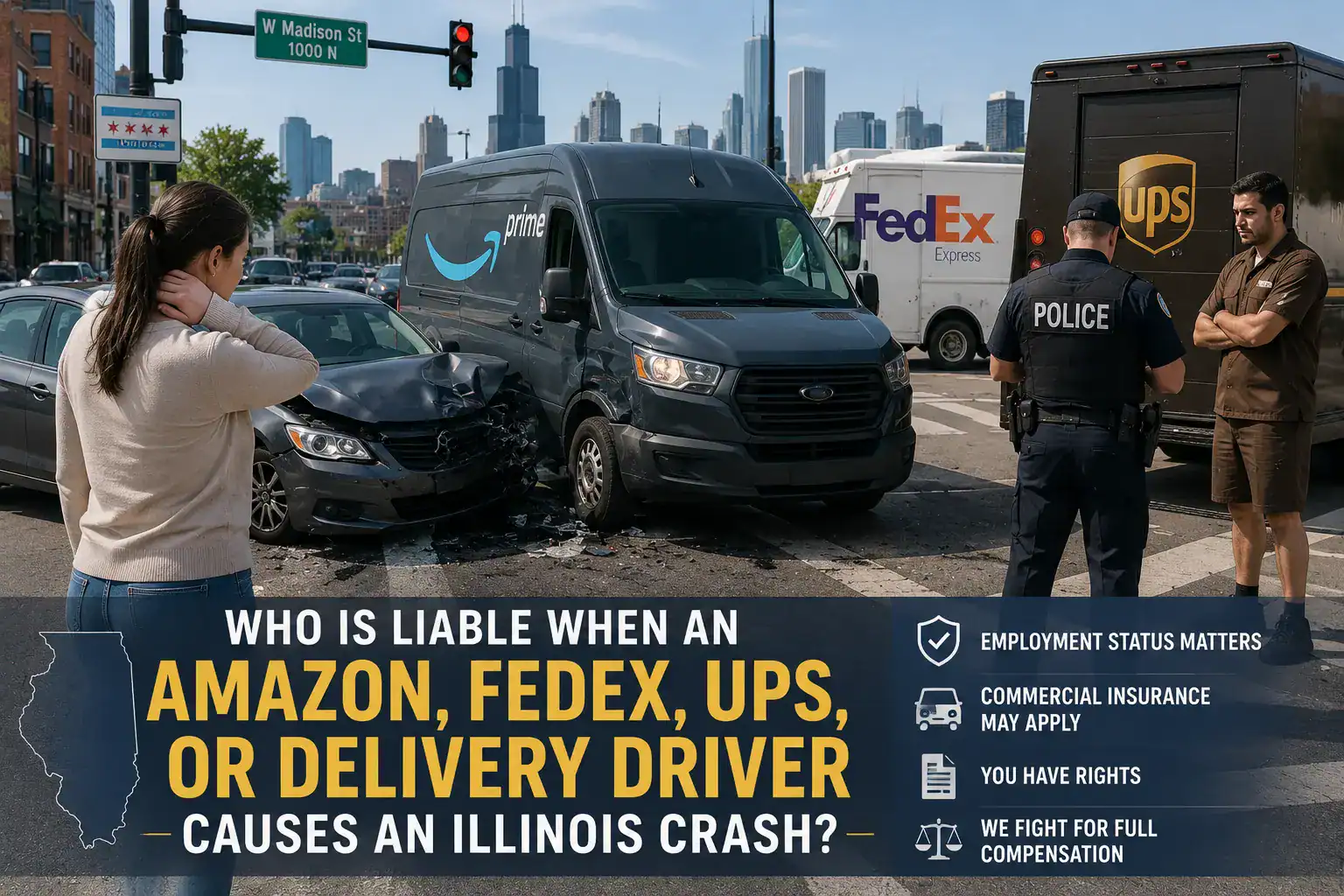
A delivery driver crash in Illinois can look simple from the outside. A van turns left across traffic, a driver backs out of an alley, or a food delivery car rear-ends you at a light. Then the claim starts, and suddenly everyone says someone else should pay.
That confusion is common because delivery crashes often involve more than one possible defendant. The driver may work for UPS, FedEx, an Amazon Delivery Service Partner, a local contractor, DoorDash, Uber Eats, Instacart, or another delivery platform. The vehicle may be owned by the company, leased by a contractor, rented, or personally owned by the driver. Each detail can change which insurance policy applies.
The core answer is this: if a delivery driver caused your Illinois crash while working, you may have a claim against the driver, the driver’s employer or contractor, the delivery company, the vehicle owner, a maintenance company, another negligent driver, or your own UM/UIM coverage. The right answer depends on the driver’s work status, vehicle ownership, delivery-app status, insurance coverage, and evidence from the crash.
This guide explains how liability works after a delivery driver crash in Illinois, which insurance layers may apply, what evidence matters most, and how injured people can avoid the common insurance traps that follow commercial and gig-driver collisions.
Key Takeaways
Delivery driver crash liability in Illinois usually starts with the negligent driver, but it may not end there. If the driver was working, the employer, contractor, delivery platform, vehicle owner, or maintenance company may share responsibility depending on the facts.
In 2024, Illinois reported 303,913 total crashes, 89,023 injuries, and 1,178 traffic deaths, according to IDOT crash data. Tractor-trailer crashes alone accounted for 11,294 crashes, including 1,750 injury crashes. Those statewide numbers matter because delivery crashes are not just property-damage disputes – they can involve serious injury, multiple policies, and commercial defendants.
Insurance coverage can be layered. Illinois requires most drivers to carry at least 25/50/20 liability limits, meaning $25,000 per person and $50,000 per accident for bodily injury and $20,000 for property damage, according to the Illinois Department of Insurance. A serious delivery crash can exceed those limits quickly, especially when a personal vehicle is being used for gig delivery.
Quick Answer: Who Pays After a Delivery Driver Crash in Illinois?
The person or company that caused the crash should pay. In practice, payment usually comes from one or more insurance policies rather than the driver’s pocket. The most common sources are the driver’s personal auto policy, a commercial auto policy, the delivery company’s coverage, a contractor’s policy, the vehicle owner’s policy, or the injured person’s uninsured/underinsured motorist coverage.
A UPS driver in a company truck may point to UPS and its commercial insurer. An Amazon-branded van may involve the driver’s DSP employer, Amazon-related contracts, and commercial coverage. A DoorDash or Instacart driver in a personal vehicle may involve personal auto insurance, platform coverage, and your own UM/UIM policy if coverage is denied or limits are too low.
The safest way to frame the case is not ‘Which logo was on the vehicle?’ but ‘Who controlled the driver, who owned or insured the vehicle, what delivery task was active, and what evidence proves the driver was working when the crash happened?’ That is where the real liability analysis begins.
Why Delivery Driver Crashes Are Legally Different From Regular Car Accidents
A regular car accident often involves two private drivers and two insurance companies. A delivery driver crash can involve a driver, an employer, a subcontractor, a national delivery brand, a gig platform, a vehicle owner, a maintenance vendor, and multiple insurers. Each one may try to shift responsibility to another party.
Delivery work also creates pressures that ordinary driving does not. Drivers may be navigating unfamiliar neighborhoods, using GPS or app instructions, stopping frequently, backing into alleys, double-parking, carrying packages, or trying to meet route deadlines. These facts do not automatically prove negligence, but they help explain why evidence such as route logs, scanner data, app status, and telematics can be important.
Commercial vehicle evidence matters because federal data treats large truck and bus crashes as a separate safety category. The Federal Motor Carrier Safety Administration publishes recurring crash facts for large trucks and buses, including fatal, injury, and property-damage crashes. A delivery crash involving a large truck, box truck, step van, or commercial fleet vehicle may require a deeper investigation than a standard fender-bender.
Who May Be Liable After an Amazon, FedEx, UPS, DoorDash, or Other Delivery Crash?
Several parties may be responsible after a delivery driver causes an Illinois crash. The strongest claim usually depends on whether the driver was on duty, whose vehicle was being used, what company controlled the work, and which insurance policy applies.
| Potential Party | When They May Be Liable | Evidence That Helps |
| Delivery driver | The driver made an unsafe turn, sped, rear-ended another vehicle, ran a light, backed unsafely, or drove distracted. | Police report, photos, witness statements, dashcam footage, citations, phone records. |
| Employer or contractor | The driver was an employee or acting within the scope of work for a contractor or delivery fleet. | Employment records, dispatch logs, route assignments, uniforms, vehicle branding, schedules. |
| Delivery platform or national brand | The company exercised control, supplied the delivery system, or may be responsible under agency, negligent hiring, or other fact-specific theories. | Contracts, app data, performance metrics, training materials, branding, delivery instructions. |
| Vehicle owner or maintenance company | Bad brakes, worn tires, poor maintenance, unsafe loading, or negligent entrustment contributed to the crash. | Inspection records, maintenance logs, repair invoices, photos of tires/brakes, expert inspection. |
| Your own insurer | The delivery driver was uninsured, underinsured, unidentified, or a coverage dispute leaves no adequate third-party policy. | UM/UIM declarations page, denial letters, policy language, police report, damages proof. |
Employee, Contractor, or Gig Driver: Why the Work Relationship Matters
The most important liability question is often whether the delivery driver was acting as an employee, contractor, or gig-app driver at the time of the crash. This is not just a paperwork issue. It affects whether the company can be held responsible for the driver’s negligence and which policy has to respond.
UPS drivers are often company employees driving company vehicles. If a UPS employee causes a crash while making deliveries, the claim may proceed against the driver and the company under employer-liability principles. FedEx-related claims can be more complicated because some operations use contractors or independent service providers. Amazon claims often involve Delivery Service Partners, which are separate companies that operate Amazon-branded routes and vehicles.
Gig delivery cases can be even more layered. DoorDash, Uber Eats, Instacart, Grubhub, and similar platforms often classify drivers as independent contractors. That does not automatically end the analysis, but it usually means the first questions are whether the driver was logged into the app, whether an active delivery was underway, and whether platform coverage is available.
A company label on a van is evidence, but it is not the whole case. A lawyer may need to obtain driver contracts, route assignments, app status, dispatch records, scanner data, or delivery manifests to prove who controlled the work and whose insurance should pay.
When the Delivery Company or Contractor May Be Liable
A delivery company, contractor, DSP, fleet owner, or platform may be liable when its own conduct helped cause the crash. This can include negligent hiring, negligent retention, negligent training, negligent supervision, unsafe routing pressure, failure to maintain a vehicle, or putting an unqualified driver behind the wheel.
For example, if a contractor hired a driver with a poor safety history and failed to review their driving record, negligent hiring may be part of the claim. If a company ignored repeated complaints about a driver speeding through residential neighborhoods, negligent supervision may matter. If a delivery van had worn brakes or bald tires and the company kept it on the road, negligent maintenance may be central.
Agency and apparent-agency theories may also matter. If a company presents a driver as part of its delivery system through branded vehicles, uniforms, route control, customer-facing communications, and performance monitoring, that evidence may support arguments that the company should not be allowed to avoid responsibility simply by calling the driver a contractor.
These claims are fact-specific. The goal is not to assume a national company is always liable or never liable. The goal is to identify who controlled the work, who benefited from the delivery, who insured the vehicle, and who failed to prevent the unsafe conduct that caused the crash.
Insurance Coverage After an Illinois Delivery Driver Crash
Delivery-driver accident claims often turn on coverage. The driver may be at fault, but the practical question is which policy has enough limits to cover medical bills, lost income, pain and suffering, and vehicle damage.
Illinois minimum liability limits are often too low for serious injury cases. The Illinois Department of Insurance explains that most motorists must carry 25/50/20 coverage. That means one seriously injured person may face a $25,000 bodily-injury limit if only a minimum personal policy applies. Emergency care, imaging, physical therapy, time off work, and long-term treatment can exceed that quickly.
Commercial policies may provide more coverage, but carriers do not volunteer the best policy first. A delivery crash may involve a personal policy, a commercial auto policy, a contractor policy, platform coverage, umbrella or excess insurance, workers’ compensation issues, and UM/UIM coverage. The order of payment can be disputed.
UM/UIM coverage can matter when the delivery driver’s insurance is missing, denied, or too small. The Illinois auto insurance shopping guide describes liability coverage as paying for bodily injury or property damage caused by negligent operation of a vehicle, but injured people should also review their own declarations page for uninsured and underinsured motorist coverage.
Realistic Examples of Liability in Illinois Delivery Crashes
Example 1: An Amazon-branded van rear-ends you on I-290. The driver says they work for a local DSP, not Amazon. The driver may be liable, the DSP’s commercial policy may apply, and further investigation may be needed to determine whether Amazon-related control, contracts, routing, or branding affect the claim.
Example 2: A DoorDash driver in a personal car runs a red light while actively delivering an order. The driver’s personal insurer may deny coverage if the policy excludes delivery use. The platform’s contingent coverage may apply if the driver was in an active delivery period, and your UM/UIM coverage may also need to be reviewed.
Example 3: A UPS truck backs into your car in an alley while the driver is making a delivery. The driver may be liable for unsafe backing, and the company may be responsible if the driver was acting within the scope of employment. Backup-camera data, route logs, witness statements, and photos of vehicle position can help prove the claim.
Example 4: A FedEx-related vehicle causes a crash, but the paperwork shows the driver works for a contractor. The claim may involve the driver, contractor, vehicle owner, and available commercial insurance. If the vehicle was poorly maintained, maintenance records may become just as important as the police report.
How Illinois Comparative Fault Can Affect a Delivery Driver Claim
Illinois uses modified comparative fault. Under 735 ILCS 5/2-1116, an injured person generally cannot recover if they are more than 50% at fault, and any recovery may be reduced by their percentage of fault. That is why insurance companies try so hard to shift blame after delivery-driver crashes.
The insurer may argue you were speeding, did not yield, stopped suddenly, failed to see the van, or were distracted. In a city crash, they may claim bike lanes, bus lanes, construction zones, or double-parking made the situation unclear. These arguments are often used to reduce settlement value even when the delivery driver’s negligence is obvious.
Evidence can limit unfair blame-shifting. Dashcam footage, traffic-camera footage, 911 timestamps, delivery app status, GPS data, vehicle damage patterns, and witness statements can show how the crash actually happened. The sooner that evidence is preserved, the harder it becomes for an insurer to rewrite the facts.
What Evidence Proves a Delivery Driver Was Working and At Fault?
Delivery crashes are evidence-heavy because the company may deny control, the driver may deny being on duty, and the insurer may deny coverage. The most important proof often includes:
- Photos of the delivery vehicle, company logo, license plate, DOT or fleet number, van ID, delivery decals, and visible damage.
- The police report, including statements, vehicle information, crash diagram, and any citations.
- Witness names, phone numbers, and short written or recorded descriptions of what they saw.
- Delivery-app status, route logs, scanner data, dispatch records, GPS history, telematics, and delivery manifests.
- Dashcam footage, business surveillance, doorbell video, traffic cameras, and nearby security cameras.
- Medical records, bills, work restrictions, pay stubs, and employer letters proving lost wages.
Illinois crash reporting rules also matter. The Illinois State Police says a driver involved in an Illinois traffic crash must file a report if the crash caused death, bodily injury, or more than $1,500 in property damage when all drivers are insured, or $500 if any driver is uninsured. If no officer appears, the report must be filed as soon as possible within 10 days.
What Should You Do After a Crash With a Delivery Driver in Illinois?
First, call 911 and get medical help. Do not let the delivery driver talk you out of a report by saying they are late, the damage is minor, or the company will handle it. A police report creates a neutral starting point for the claim.
Second, photograph everything before vehicles move if it is safe to do so. Capture the delivery vehicle, brand markings, license plate, fleet number, vehicle position, damage, debris, traffic signals, lane markings, road conditions, and visible injuries. If the driver has an app open or is scanning packages, do not grab the phone, but note what you saw and tell the officer.
Third, get the driver’s personal information and work information. Ask for the driver license, insurance, employer or contractor name, vehicle owner, and the delivery platform or company involved. If the driver says they are a contractor, write down the contractor’s name.
Fourth, get medical care promptly and keep the paper trail. Delivery-company insurers often argue that a delay in treatment means the injuries were not caused by the crash. Consistent records make that argument harder.
Fifth, avoid recorded statements to the delivery company’s insurer until you understand the coverage picture. A recorded statement can be used to create comparative-fault arguments, downplay injury symptoms, or lock you into details before all evidence is available.
Common Insurance Defenses After Amazon, FedEx, UPS, and Gig Delivery Crashes
Delivery-driver insurers and company lawyers often use the same set of defenses. They may say the driver was off duty, the driver was an independent contractor, the vehicle was personally owned, the company did not control the route, the crash was caused by another driver, or your injuries are not related to the collision.
In gig-driver cases, the insurer may focus on app status. Was the driver logged in? Had they accepted an order? Were they traveling to a pickup, carrying food or packages, or waiting between orders? Small timing differences can decide whether personal insurance, platform coverage, or no third-party coverage applies.
In contractor cases, the defense may focus on corporate structure. A national company may argue the local contractor is the only responsible party. A contractor may argue the driver was outside the scope of work. The driver may argue the app or company pushed unsafe deadlines. These disputes are exactly why early evidence preservation matters.
What Compensation Can You Recover After a Delivery Driver Crash?
If a delivery driver, employer, contractor, platform, vehicle owner, or another party caused your Illinois crash, compensation may include both economic and non-economic damages. Economic damages include ambulance bills, ER care, surgery, imaging, medication, physical therapy, future medical treatment, lost wages, reduced earning capacity, vehicle damage, and out-of-pocket costs.
Non-economic damages include pain and suffering, emotional distress, loss of normal life, disability, disfigurement, and the day-to-day limits caused by the injury. A neck injury that prevents driving, a concussion that makes work harder, or a back injury that stops a person from lifting children or doing their job may be part of the claim.
In severe delivery crashes, damages can grow quickly because commercial vehicles and loaded vans can create greater force than a small passenger-car collision. The right insurance layer matters because the value of the injury claim may exceed a minimum personal policy.
How Long Do You Have to File a Delivery Driver Crash Claim in Illinois?
Most Illinois personal injury lawsuits must be filed within two years under 735 ILCS 5/13-202. Property-damage claims may have a different limitation period; 735 ILCS 5/13-205 generally provides a five-year period for injury to personal property. These lawsuit deadlines are not the same as insurance notice deadlines, which may be much shorter.
Do not wait two years to investigate a delivery crash. App data can disappear, surveillance footage can overwrite, drivers can change jobs, contractors can close, vehicles can be repaired, and telematics can become harder to obtain. The strongest delivery-driver claims usually start with preservation letters sent quickly to the driver, employer, contractor, platform, vehicle owner, and insurer.
Talk to Eliasik Law About an Illinois Delivery Driver Crash
If an Amazon, FedEx, UPS, DoorDash, Instacart, Uber Eats, or other delivery driver caused your crash, do not let the insurance companies turn a clear injury claim into a coverage maze. Contact The Law Offices of John S. Eliasik for a free case evaluation. The firm can review the crash, identify the responsible parties, preserve delivery and telematics evidence, and explain which insurance policies may apply.
FAQs
Who is liable when an Amazon delivery driver causes an Illinois crash?
The driver may be liable, but Amazon delivery crashes often require deeper analysis because many Amazon-branded vans are operated by Delivery Service Partners. The DSP, driver, vehicle owner, maintenance provider, available commercial policies, and sometimes Amazon-related control issues may all need to be investigated.
Can I sue UPS or FedEx after one of their drivers hits me?
Yes, if the driver was working and the company or its contractor is legally responsible. UPS claims often involve company employment and commercial coverage. FedEx claims may involve different operating structures, contractors, or service providers. The exact defendant depends on who employed or controlled the driver and who owned or insured the vehicle.
What if a DoorDash, Uber Eats, Instacart, or Grubhub driver caused the crash?
Gig-driver crashes are usually coverage-driven. The driver may have personal auto insurance, but personal policies may exclude commercial delivery use. Platform coverage may apply depending on whether the driver was logged in, waiting for an order, traveling to a pickup, or actively delivering. Your own UM/UIM coverage may also matter.
What if the delivery company says the driver was an independent contractor?
Independent-contractor status can complicate the claim, but it does not automatically end it. A lawyer may investigate agency, control, negligent hiring, negligent entrustment, negligent supervision, vehicle ownership, insurance coverage, branding, app data, and route control to determine whether the company or contractor can still be held responsible.
What evidence should I preserve after a delivery driver crash?
Preserve photos of the vehicle, company logos, license plate, fleet number, damage, roadway, debris, traffic signs, and injuries. Get the police report, witness contact information, medical records, and insurance details. If possible, identify the delivery app, contractor, driver employer, route number, or vehicle ID before evidence disappears.
Who pays if the delivery driver only has minimum insurance?
If the driver has only minimum insurance and your damages exceed the available limits, other sources may be needed. These can include a commercial policy, contractor policy, platform coverage, vehicle-owner coverage, umbrella or excess coverage, or your own underinsured motorist policy. The answer depends on the delivery status and policy language.
Can a delivery company be liable for bad vehicle maintenance?
Yes. If worn brakes, unsafe tires, poor loading, steering problems, or missed inspections contributed to the crash, the vehicle owner, delivery contractor, maintenance company, or employer may be liable. Maintenance logs, inspection records, repair invoices, and expert vehicle inspections can be important.
How long do I have to file a claim after a delivery driver crash in Illinois?
Most Illinois injury lawsuits have a two-year deadline, but insurance notice requirements and evidence-preservation needs can arise much sooner. Property-damage claims may follow a different deadline. Because delivery data and surveillance footage may be lost quickly, it is best to act immediately rather than waiting near the lawsuit deadline.
Disclaimer: This article is provided by Eliasik Law for general informational purposes only and does not constitute legal advice. Reading this content does not create an attorney-client relationship. Laws, fees, regulations, and court decisions referenced may change. For advice on your specific situation, please contact Eliasik Law directly to schedule a consultation.