
Table of Contents
Yes, you may be able to sue the City of Chicago for a sidewalk injury. A successful claim requires more than showing that you fell on public property. You must establish an applicable duty, an unsafe condition, a breach that caused your injuries, and the required notice of the condition. Governmental defenses can also affect the claim.
For a typical negligence claim against the city, the general lawsuit deadline is one year from the injury or accrual of the claim. Do not assume the two-year deadline commonly associated with private-party injury cases applies. A 311 report or an informal claim does not, by itself, preserve your right to sue.
Key Takeaways
- The city is not automatically liable for every cracked sidewalk or pedestrian fall.
- For covered sidewalk claims, actual or constructive notice of the unsafe condition must exist sufficiently before the injury to allow protective action.
- The general lawsuit deadline against the city is one year, subject to the applicable law and any exceptions.
- The former general pre-suit notice requirement has been repealed. There is no general six-month City Clerk notice requirement for an ordinary Chicago sidewalk negligence lawsuit.
- A neighboring owner, contractor, or utility may be relevant if its conduct or legal responsibilities contributed to the hazard.
When Can Chicago Be Responsible for an Unsafe Sidewalk?
Section 3-102 of the Illinois Tort Immunity Act addresses a local public entity’s duty to maintain its property in a reasonably safe condition for people who are both intended and permitted users exercising ordinary care. A pedestrian using a public sidewalk for walking ordinarily presents a different issue from someone using a roadway, parkway, or restricted area.
The exact location matters. Investigators should determine whether the fall occurred on city property, another public entity’s property, or a private walkway. A Chicago mailing address does not establish which entity owns or controls the particular surface.
A claim also needs evidence connecting the specific defect to the fall and resulting harm. Medical records document injuries, but they do not establish who controlled the sidewalk or why it was unsafe.
What Does It Mean That the City Had Notice?
Section 3-102 requires proof of actual or constructive notice of the unsafe condition sufficiently before the injury to allow measures to remedy it or protect against it. These are different ways of establishing knowledge; the statute does not universally require a prior written complaint.
Actual Notice
Actual notice concerns the city’s knowledge of the particular condition. Relevant evidence may include an earlier service request, an inspection report, a documented complaint, or testimony about city employees’ observations. The location, description, timing, and recipient of a complaint all matter. A report about a different crack on the same block may not establish notice of the defect involved in your fall.
Constructive Notice
Constructive notice can depend on how evident the condition was and how long it existed. In Burns v. City of Chicago, the appellate court explained that proof of duration and visibility can matter and found the evidence insufficient to establish constructive notice of raised sidewalk tiles.
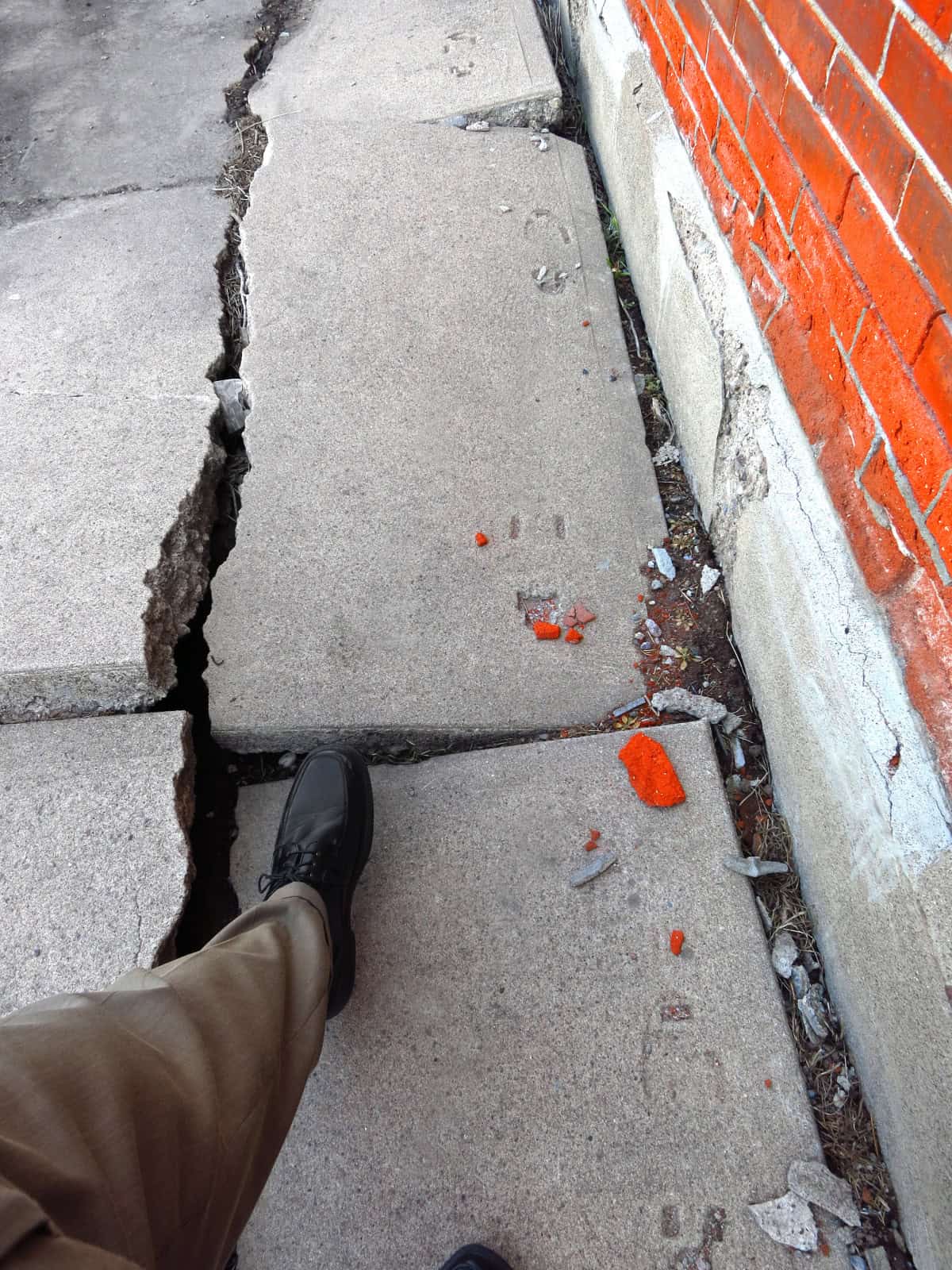
Dated photographs, earlier complaints, nearby witnesses, inspection records, and repair history may help. A photograph taken after the fall can show the condition then, but it may not establish how long that condition existed beforehand.
Reporting Your Injury Is a Separate Issue
A report you make after the fall can document the incident and request repairs. It does not, by itself, prove the city had notice before you were injured. Keep the service-request number and a copy of what you submitted, and distinguish the accident report from evidence of earlier knowledge.
How Long Do You Have to Sue the City of Chicago?
Under 745 ILCS 10/8-101(a), covered injury actions against local public entities and their employees generally must be filed within one year from the injury or accrual of the cause of action. That shortened period is a central concern in an ordinary city sidewalk negligence case.
The former general notice provision, Section 8-102, is repealed. Do not follow a sequence that tells you to notify the City Clerk within six months, wait for a denial, and then sue within two years.
Exceptions, the identity of each defendant, and other claim-specific rules require individual review. Do not assume a records request, settlement discussion, repair request, or administrative claim stops the lawsuit clock. A report to the city is not a substitute for filing and properly pursuing a timely lawsuit.
How Serious Must a Sidewalk Defect Be?
Illinois courts apply a de minimis rule that can exclude slight sidewalk imperfections from liability. There is no universal one-inch threshold that automatically makes a defect actionable.
In Monson v. City of Danville, the Illinois Supreme Court explained that there is no mathematical formula or bright-line test. Relevant circumstances can include the height difference between slabs, pedestrian traffic, and the location’s commercial or residential character.
Measure the condition if it is safe to do so, but also document the wider setting, lighting, walking route, and anything obscuring the surface. A ruler alone does not establish that the city was negligent.
Can an Open and Obvious Defect Defeat the Claim?
The open and obvious doctrine can weigh against imposing a duty when a reasonable person would recognize both the condition and its risk. It is part of the legal duty analysis, not simply a rule reducing compensation because you failed to look down.
In Bruns v. City of Centralia, the Illinois Supreme Court rejected an asserted distraction based merely on looking toward a clinic entrance instead of the known sidewalk defect. The court emphasized that an actual distraction and its reasonable foreseeability matter.
Illinois recognizes distraction and deliberate-encounter exceptions in appropriate circumstances, but neither applies automatically. Simply being distracted, choosing a route, or saying the defect was difficult to avoid does not establish an exception. The court still evaluates the applicable duty factors.
Does Governmental Immunity Prevent Every Sidewalk Lawsuit?
No, but a viable negligence theory must also withstand any applicable statutory defenses. The duty to maintain public property does not erase the Act’s separate immunity provisions.
For example, Monson addressed discretionary immunity involving a city’s failure to repair a sidewalk. The court required evidence supporting the claimed policy determination and exercise of discretion as to the conduct at issue. A broad statement that sidewalk repairs involve choices did not, by itself, establish the defense.
The location and alleged conduct may raise other defenses. An attorney should evaluate the precise facts rather than assume the city is either always immune or automatically responsible once a defect is reported.
Can You Sue a Neighboring Property Owner or Contractor?
A private owner is not automatically liable merely because the public sidewalk runs in front of its property. The investigation must identify a legal duty and conduct connected to the injury.
The Illinois jury instruction on owners of property abutting sidewalks explains that an owner must exercise ordinary care not to create an unsafe condition interfering with normal sidewalk use. Altering or appropriating the sidewalk for a private purpose can also affect the analysis.
A contractor or utility may be relevant if excavation, construction, or repair work created the defect. A private walkway or entrance can raise different premises-liability questions from the public sidewalk beside it. A lease, permit, or maintenance agreement may be useful evidence, but it does not automatically establish liability to an injured pedestrian.
Related principles are discussed in Eliasik Law’s guide to evaluating a premises-liability claim. Each potential defendant’s duties and deadlines need separate review.
What If Snow or Ice Caused the Fall?
Weather-related falls require separate analysis. Section 3-105 of the Tort Immunity Act provides protection for injuries caused by the effects of weather conditions as such on sidewalks and other public ways. Snow, ice, drainage, the underlying pavement, and any work that changed the condition can raise different questions.
Do not assume that failure to shovel, partial clearing, or an alleged ordinance violation makes the city liable. Nor does a private party’s snow-removal obligation automatically resolve a civil injury claim. Preserve photographs and weather-related details promptly because conditions can change quickly.
What Compensation May Be Available?
If liability and damages are established, compensation may include reasonable medical expenses, lost earnings, reduced earning capacity, pain and suffering, disfigurement, and loss of normal life when supported by the evidence. Future losses require appropriate proof.
The Tort Immunity Act does not impose the general municipal compensatory-damages dollar cap sometimes described in online summaries. However, Section 2-102 bars punitive or exemplary damages against a local public entity. That protection is different from a general cap on compensation for proven injuries.
Illinois’s modified comparative-fault rule also matters. In covered negligence actions, fault of more than 50% bars recovery. At 50% or less, damages are reduced proportionally. An allegation by the defense is not a final finding of fault.
What Evidence Should You Preserve After a Sidewalk Fall?
- The exact address and spot where the fall occurred, including nearby landmarks.
- Close-up and wider photographs of the defect, its dimensions, surrounding pavement, lighting, and obstructions.
- The date, time, weather, route you took, and a factual account of how you fell.
- Witness names and contact details, including people familiar with the condition before the accident.
- Relevant footwear and clothing, original photographs, and messages about the incident.
- Medical records, bills, wage-loss documentation, and evidence of ongoing limitations.
- Earlier service requests, inspection records, repair records, permits, and dated images when available.
Some records may be obtainable through public-records requests; others may require formal litigation procedures, and exemptions can limit disclosure. Video may be overwritten, so ask promptly about preservation. A records request does not guarantee that particular evidence exists or will be released.
Prioritize your health. Seek appropriate treatment, follow medical advice, and call emergency services for an urgent injury. Do not enter traffic, trespass, or recreate a fall to obtain photographs. Before signing a release or giving a recorded statement, understand the request and any obligations that may apply.
Discuss Your Chicago Sidewalk Injury With Eliasik Law
If you were injured on a Chicago sidewalk, Eliasik Law can review the circumstances and discuss potential defendants, evidence-preservation needs, and the filing rules that may apply. Bring any photographs, treatment records, witness details, and city service-request information you have.
Contact Eliasik Law or request a free consultation to discuss your options. You can also learn about the firm’s personal injury practice.
Frequently Asked Questions
Can I sue if I tripped on a cracked Chicago sidewalk?
Possibly. The claim depends on the responsible entity, the condition, notice, causation, damages, and applicable defenses. A crack and an injury alone do not establish liability.
Do I have two years to sue the city?
For an ordinary sidewalk negligence claim against Chicago, the general deadline is one year under Section 8-101(a). Have the actual deadline evaluated promptly rather than relying on the private-party two-year rule.
Must I send the City Clerk a notice within six months?
There is no general six-month pre-suit City Clerk notice requirement for an ordinary Chicago sidewalk negligence lawsuit under the Tort Immunity Act. The former general notice section is repealed. Timely filing of the lawsuit remains essential.
Does the city need a written complaint before it can be liable?
Not necessarily. The statute recognizes actual or constructive notice of the unsafe condition with sufficient time to respond. A prior written complaint can be evidence, but it is not the only possible way to establish notice.
Does reporting the defect to 311 preserve my lawsuit?
No. A service request can document a condition and seek repairs, but it is not a lawsuit and does not, by itself, pause the filing deadline. A report after the fall also does not prove earlier notice.
Is the neighboring business automatically responsible?
No. Its ownership, control, alteration or use of the walkway, and any conduct creating the hazard must be examined. A business’s proximity to the public sidewalk is not enough by itself.
What if the sidewalk was repaired before I photographed it?
Witnesses, earlier images, service requests, permits, video, and repair records may still help. Explain the timing to an attorney and preserve the evidence you already have. A later repair does not automatically prove negligence.
This article provides general information about Illinois law, not legal advice. It does not create an attorney-client relationship. Duties, deadlines, defenses, and outcomes depend on the facts and applicable law.