
Table of Contents
Getting blamed for an accident can make the entire claims process feel confusing and unfair. Maybe you think you made a mistake, or maybe the insurance company is already suggesting you were partly responsible. Either way, you may be wondering whether you still have the right to file a claim at all.
In Illinois, being partially at fault does not always mean you are out of options. A partially at fault accident claim in an Illinois case may still allow you to pursue compensation, depending on how fault is divided and what the evidence shows.
This blog will explain how Illinois handles shared fault, how your percentage of responsibility can affect your compensation, and why insurance companies may try to shift blame onto you. You will also learn what evidence can help protect your claim, what mistakes to avoid after an accident, and when it may be time to speak with a personal injury lawyer.
What Does It Mean to Be Partially at Fault for an Accident?
Being “partially at fault” does not always mean you caused the accident. It usually means more than one person’s actions may have contributed to what happened. In real life, accidents are rarely as neat as one person being 100% right and the other being 100% wrong.
For example, maybe another driver ran a red light, but the insurance company argues you were speeding. Or maybe you slipped at a store, but the store claims you were looking at your phone instead of watching where you were walking. These are the kinds of situations where fault becomes disputed.
Illinois law recognizes this. Under Illinois’ modified comparative negligence rule, an injured person’s compensation may be reduced by their share of fault, and recovery can be barred if they are found more than 50% responsible.
That matters because fault arguments are common after serious accidents. In 2023, Illinois recorded 299,133 motor vehicle crashes, according to the Illinois Department of Transportation’s Crash Facts report. With that many collisions, it is no surprise that insurance companies often look closely at who did what, when, and why.
So, if you are worried about a partially at fault accident claim in the Illinois situation, the key question is not simply, “Did I make any mistake?” The better question is, “How much did my actions actually contribute to the accident, and what evidence proves it?”
Can You Still File a Claim If You Were Partially at Fault in Illinois?
Yes, you may still be able to file an accident claim in Illinois even if you were partially at fault. The important issue is how much fault is assigned to you.
Illinois follows a modified comparative negligence rule. Under state law, an injured person is barred from recovering damages if their fault is more than 50% of the cause of the injury or damage. If their fault is not more than 50%, they may still recover compensation, but the amount can be reduced based on their percentage of fault.
Here is a simple way to think about it. If another driver was mainly responsible for a crash, but you were also found 20% at fault, your claim may not disappear. Instead, your compensation could be reduced by that 20%. But if the other side can push your share of fault above 50%, your ability to recover may be lost.
That is why you should be careful about assuming the insurance company’s version of events is accurate. An adjuster might say you were “partly responsible,” but that does not automatically mean their percentage is fair, final, or supported by the evidence.
In a partially at-fault accident claim in Illinois, the details matter: who had the right of way, what each person could see, whether anyone violated a traffic law, what witnesses observed, and what the physical evidence shows.
So, the answer is not simply yes or no. The better answer is this: you can still file a claim if you were partially at fault in Illinois, but the strength and value of that claim depend on the facts, the evidence, and your assigned percentage of responsibility.
Related: Hit by an Uninsured Driver in Illinois? What You Need to Know
How Illinois’ Comparative Negligence Rule Works
Illinois uses a rule called modified comparative negligence, which is the legal way of saying fault can be shared. Instead of treating every accident as all-or-nothing, the law looks at each person’s role in causing the injury.
Under Illinois law, you are generally barred from recovering damages if your share of fault is more than 50%. If your share of fault is 50% or less, you may still recover damages, but your compensation is reduced by your percentage of fault.
So, imagine someone is hit in a crash, and their damages are valued at $100,000. If they are found 20% at fault, their recovery could be reduced by 20%, leaving $80,000. But if they are found 51% at fault, they may recover nothing under Illinois’ rule.
This is where many injured people get nervous. They hear the phrase “you were partly at fault” and assume the claim is over. That is not always true. The real question is whether the facts place you at or below that 50% line.
The Illinois Department of Insurance also explains that insurance companies may review statements, witness accounts, and accident reports when deciding how much fault to assign. That means a partially at fault accident claim in an Illinois case can turn on the small details: who had the right of way, whether anyone was distracted, how fast each person was going, and what the physical evidence shows.
This is why fault should not be accepted too quickly. An insurance company’s first opinion is not the same thing as the final truth.
How Partial Fault Can Reduce Your Accident Compensation
A partial fault does not just affect whether you can bring a claim. It can also affect how much money you may actually recover.
Illinois law says that when an injured person is not more than 50% at fault, their damages are reduced in proportion to their share of responsibility. In simple terms, the more fault assigned to you, the less compensation you may receive.
Here is a practical example. Say your total damages are $80,000, including medical bills, lost income, pain and suffering, and other losses. If you are found 25% at fault, your recovery could be reduced by 25%. That would leave $60,000 instead of the full $80,000.
That is why fault percentages matter so much. A disagreement over whether you were 10%, 25%, or 45% responsible is not just a technical argument. It can change the value of your claim by thousands of dollars.
Insurance companies know this. The Illinois Department of Insurance explains that insurers may review statements, witness accounts, and accident reports when deciding what offer to make in a comparative negligence situation. So, if an adjuster says you were partly responsible, that opinion may directly affect the settlement offer you receive.
This is one of the biggest concerns in a partially at fault accident claim in an Illinois case. You are not only trying to prove that someone else caused the accident. You may also need to push back against an unfair percentage of blame being placed on you.
Why Insurance Companies May Try to Blame You
After an accident, it can feel personal when the insurance company starts pointing the finger at you. But in many cases, this is not really about fairness. It is about money.
Because Illinois allows compensation to be reduced by your percentage of fault, even a small blame shift can lower the value of your claim. If the insurance company can argue you were 20% responsible, that may reduce what they offer. If they can push your fault above 50%, your claim may be denied under Illinois’ modified comparative negligence rule.
The Illinois Department of Insurance explains that insurers may interview the people involved, speak with witnesses, and review the accident report when deciding what offer to make in a comparative negligence situation. That means the words you use, the details in the report, and even casual comments at the scene can matter later.
For example, imagine a driver hits you while turning left, but the adjuster says you “should have slowed down sooner.” Or a store claims you should have seen a wet floor, even though there was no warning sign nearby. These arguments do not always mean you caused the accident. They may simply be attempts to reduce the payout.
This is why a partially at fault accident claim in an Illinois case should not be judged only by what the insurance company says. Their first version of the story may leave out key evidence, minimize the other party’s actions, or make your conduct seem worse than it really was.
Common Illinois Accidents Where Fault May Be Shared
Shared fault can come up in almost any personal injury case. It is especially common when both sides tell different stories about what happened in the moments before the accident.
In a car accident, for example, one driver may say the other person ran a red light, while the other argues they were speeding or distracted. In a rear-end crash, the rear driver is often blamed first, but there may still be questions about sudden stops, broken brake lights, poor weather, or unsafe lane changes.
A partial fault can also become an issue in pedestrian and bicycle accidents. A driver may claim the pedestrian crossed outside a crosswalk, or that a cyclist was hard to see. But that does not automatically excuse the driver. The full picture matters, including speed, visibility, traffic signals, road conditions, and whether the driver was paying attention.
Slip and fall cases can involve similar blame-shifting. A store may argue the injured person should have noticed the hazard, while the injured person may point out that there was no warning sign, poor lighting, or a spill that employees had time to clean up.
The same can happen in truck accidents, motorcycle crashes, rideshare collisions, dog bite incidents, and premises liability claims. In each situation, the insurance company may look for a way to say, “You had some responsibility too.”
That is why a partially at fault accident claim in an Illinois case should be treated carefully from the beginning. The type of accident matters, but the evidence matters more. Even when fault seems shared at first, a closer investigation may show that the other party had a much greater role in causing the injury.
What Evidence Can Help Protect Your Claim?
When a fault is being argued, evidence can make the difference between “the insurance company says” and “the facts show.” This matters because insurers may interview the people involved, speak with witnesses, and review the accident report before deciding how much to offer in a comparative negligence claim.
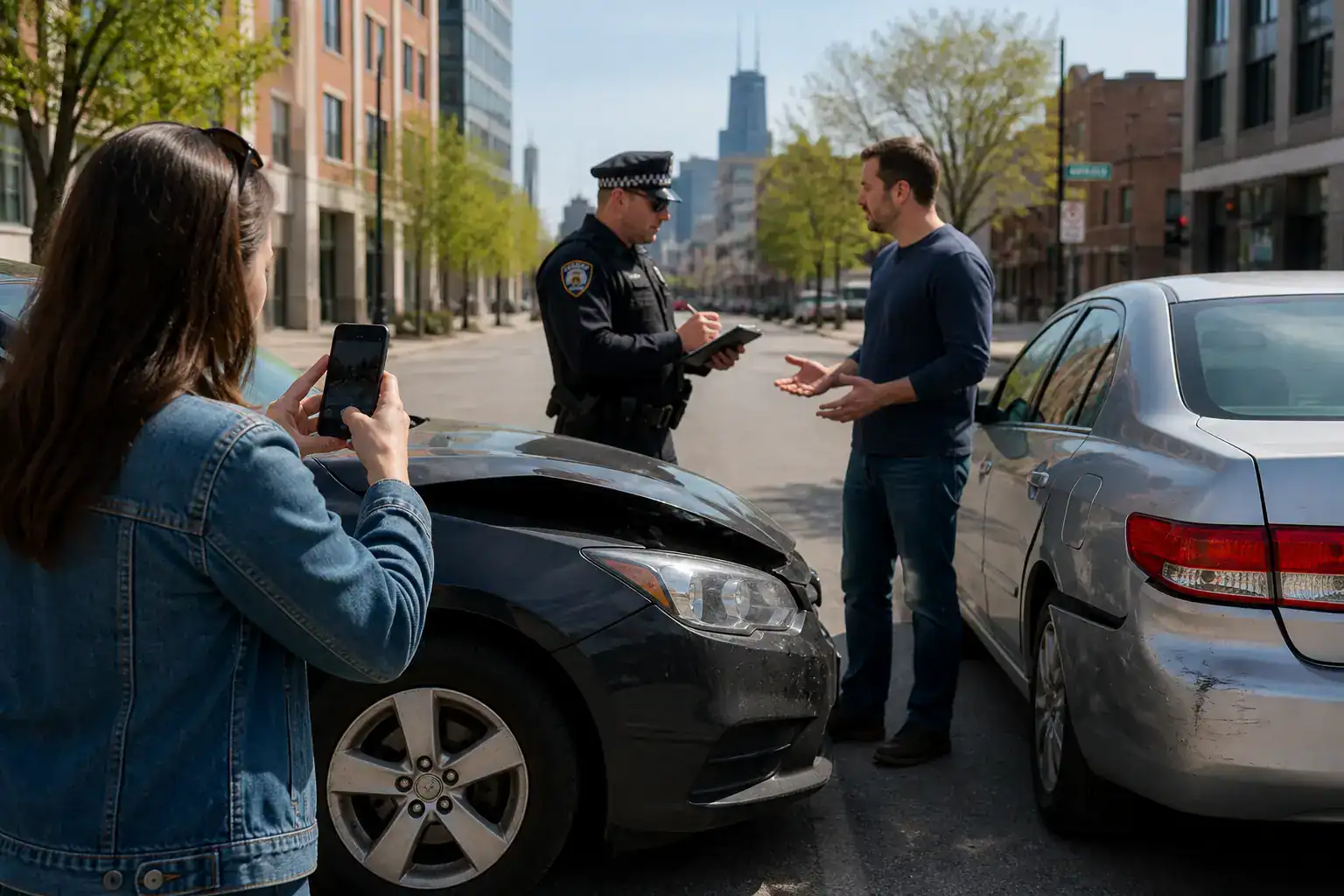
Start with anything that shows how the accident actually happened, not just how someone describes it later. Photos of the scene, vehicle damage, skid marks, traffic signals, weather conditions, broken stairs, wet floors, missing warning signs, or poor lighting can all help explain who had the better chance to prevent the accident.
Witness statements can also be powerful. A neutral witness may remember that the other driver was speeding, that a store employee walked past a spill without cleaning it, or that you had no realistic way to avoid the hazard. Medical records matter too, especially because they connect your injuries to the accident and show that you took the situation seriously.
In some cases, stronger evidence may include dashcam footage, surveillance video, 911 records, repair estimates, black box data from a vehicle, or expert analysis. You do not need every type of evidence in every case, but the earlier it is preserved, the better.
For a partially at fault accident claim Illinois case, the goal is not just to prove you were hurt. It is also to push back against an unfair fault percentage. The more clearly the evidence shows what happened, the harder it becomes for an insurance company to exaggerate your role in the accident.
What Should You Avoid Saying After an Accident?
After an accident, most people are shaken up. It is normal to feel embarrassed, scared, or even apologetic, especially if someone else is hurt or upset. But in a disputed fault case, casual words can take on a bigger meaning later.
One of the biggest mistakes is saying something like, “I’m sorry, it was my fault,” before anyone has reviewed the evidence. You may only mean, “I’m sorry this happened,” but an insurance company may treat it like an admission. The same goes for guessing. Saying “I didn’t see them” or “Maybe I was going too fast” can create problems if you do not yet know the full facts.
It is better to stick to what you know. You can check on others, call 911, get medical help, exchange information, and cooperate with police without speculating about fault. If an insurance adjuster contacts you quickly, be careful with recorded statements. Illinois’ comparative negligence system allows compensation to be reduced by your percentage of fault, so your words may influence how the insurer frames the claim.
This does not mean you should be rude or uncooperative. It simply means you should avoid filling in the blanks when you are stressed, injured, or unsure. In a partially at fault accident claim in the Illinois situation, the safest approach is to let the evidence tell the story.
What If You Think You Made a Mistake?
A lot of injured people blame themselves too quickly. They replay the accident over and over and think, “If I had looked sooner,” “If I had taken a different route,” or “If I had reacted faster, maybe this would not have happened.”
That feeling is understandable, but it is not the same as legal fault.
For example, maybe you were driving slightly under stress, but the other driver still blew through a stop sign. Maybe you looked down for a moment in a grocery aisle, but the store still failed to clean up a spill or place a warning sign. Maybe you hesitated before crossing the street, but the driver still had enough time to stop.
Illinois law focuses on whether your conduct was a proximate cause of the injury and how much fault should be assigned to each side. If your share of fault is not more than 50%, damages may still be available, though reduced by your percentage of responsibility.
So, do not decide your own case against yourself. A mistake may matter, but it may not matter as much as the insurance company says. The real question is whether the evidence shows you were mostly responsible, partly responsible, or being blamed unfairly.
How a Personal Injury Lawyer Can Help When Fault Is Disputed
When a fault is disputed, a personal injury lawyer’s job is not just to file paperwork. It is to slow the process down, gather the right evidence, and challenge the version of events that unfairly shifts blame onto you.
That can include reviewing the police report, locating witnesses, checking photos or video, preserving surveillance footage, examining vehicle damage, reviewing medical records, and looking for inconsistencies in the insurance company’s position. In some cases, a lawyer may also work with accident reconstruction experts or other professionals to explain how the injury actually happened.
This matters because insurance companies do not simply pay claims based on sympathy. The Illinois Department of Insurance explains that insurers may interview the involved parties and witnesses, review accident reports, and make offers based on their view of comparative negligence. If the parties cannot agree, the courts may ultimately decide on comparative negligence.
For someone dealing with a partially at fault accident claim Illinois case, legal help can be especially important when the insurer’s fault percentage feels exaggerated. A lawyer can push back against unfair blame, calculate the full value of your losses, and help protect your claim before deadlines or early statements create avoidable problems.
Talk to an Illinois Personal Injury Lawyer Before Accepting the Blame
If the insurance company says you were partly responsible, do not assume that is the final word. Fault percentages can be challenged, especially when the insurer is relying on incomplete facts, unclear statements, or a version of the accident that leaves out important evidence.
John S. Eliasik, Personal Injury Lawyer, helps injured people understand their rights after serious accidents in Illinois. If you are being blamed for an accident or your settlement offer seems lower than expected, getting legal guidance early can help you protect your claim, avoid costly mistakes, and understand what your case may truly be worth.
FAQs
Can I still file a claim if I was partially at fault in Illinois?
Yes. In Illinois, you may still file a claim if you were not more than 50% responsible for the accident. Your compensation may be reduced by your percentage of fault.
What is the 50% fault rule in Illinois?
The 50% rule means you can recover damages if you are 50% or less at fault. If you are found more than 50% responsible, Illinois law may bar you from recovering compensation.
How does a partial fault affect my accident settlement?
A partial fault can lower your settlement. For example, if you are 20% at fault, your compensation may be reduced by 20%, depending on the value of your damages.
Who decides who was at fault after an accident?
Insurance companies may make an initial fault decision after reviewing statements, witness accounts, and accident reports. If the fault is disputed, the issue may later be decided through negotiations, litigation, or trial.
What if the insurance company says I caused the accident?
Do not assume the insurer is correct. Insurance companies may use comparative negligence arguments to reduce or deny claims, but their decision can be challenged with evidence.
Can I recover compensation if I was 50% at fault?
Yes, Illinois law may still allow recovery if you are exactly 50% at fault. However, your damages would generally be reduced by that 50% fault share.
What happens if I am 51% at fault in Illinois?
If you are found 51% or more at fault, you may be barred from recovering damages. That is why even a small dispute over fault percentage can make a major difference.
What evidence can help if I am blamed for an accident?
Photos, videos, accident reports, witness statements, medical records, and surveillance footage may help challenge unfair blame. The goal is to show what actually happened, not just what the insurer claims happened.
Should I give a recorded statement if fault is disputed?
Be careful. A recorded statement may be used to assign more fault to you, especially if you guess, apologize, or explain events while injured or stressed. It is often wise to get legal guidance first.
Is it worth calling a lawyer if I may be partially at fault?
Yes, especially if the insurer is blaming you or reducing your offer. A lawyer can review the evidence, challenge unfair fault percentages, and help protect the value of your claim.