
Table of Contents
In Illinois, the driver or drivers who caused the chain reaction usually pay through their auto insurance, but the answer depends on the crash sequence. The Law Offices of John S. Eliasik helps injured drivers sort out multi-car pileups where one impact pushes a vehicle into another, several insurers blame each other, or the police report does not capture every detail.
Chain-reaction crashes are common enough to deserve careful treatment. IDOT’s 2024 Illinois Crash Facts & Statistics reported 303,913 motor vehicle crashes statewide, including 63,109 injury crashes and 1,085 fatal crashes. Front-to-rear collisions were the single largest injury-crash category, with 14,293 injury crashes and 74,505 total crashes. Those numbers explain why rear-end chain reactions on I-290, the Dan Ryan, local Chicago streets, and suburban roads can become high-stakes insurance disputes fast.
The simple rule is that the at-fault driver’s liability coverage should pay. The harder question is who caused which impact. A middle driver may be an innocent victim pushed forward by a rear impact. More than one driver may share fault if several vehicles were following too closely, speeding, distracted, or braking late. This guide explains who pays after a chain-reaction car accident in Illinois, how fault is assigned, what insurance coverage may apply, and what evidence protects your claim.
| Key Takeaways Who pays after a chain-reaction car accident in Illinois depends on the collision sequence, not just the number of vehicles involved. The rear driver who starts the chain often pays for downstream damage, but multiple drivers can share fault. Illinois uses modified comparative negligence, so an injured person can recover if they are not more than 50% at fault, with damages reduced by their percentage of responsibility. Evidence such as vehicle positions, damage patterns, dashcam footage, witness statements, police reports, event data, and medical records is often what decides the claim. |
Who Pays After a Chain-Reaction Car Accident in Illinois?
The at-fault driver’s insurance pays after a chain-reaction car accident in Illinois. If one driver rear-ends a stopped vehicle and pushes that vehicle into another car, the rear driver may be responsible for the injuries and property damage caused by the entire sequence. That does not mean every chain-reaction case is automatic. The insurance company will look for any argument that another driver also contributed.
A useful way to think about these cases is by separating the impacts. Who caused the first impact? Did that impact push another vehicle forward? Did the middle vehicle already hit the car ahead before being struck from behind? Did a driver make the situation worse by following too closely, speeding, looking at a phone, or changing lanes unsafely? Each answer affects who pays.
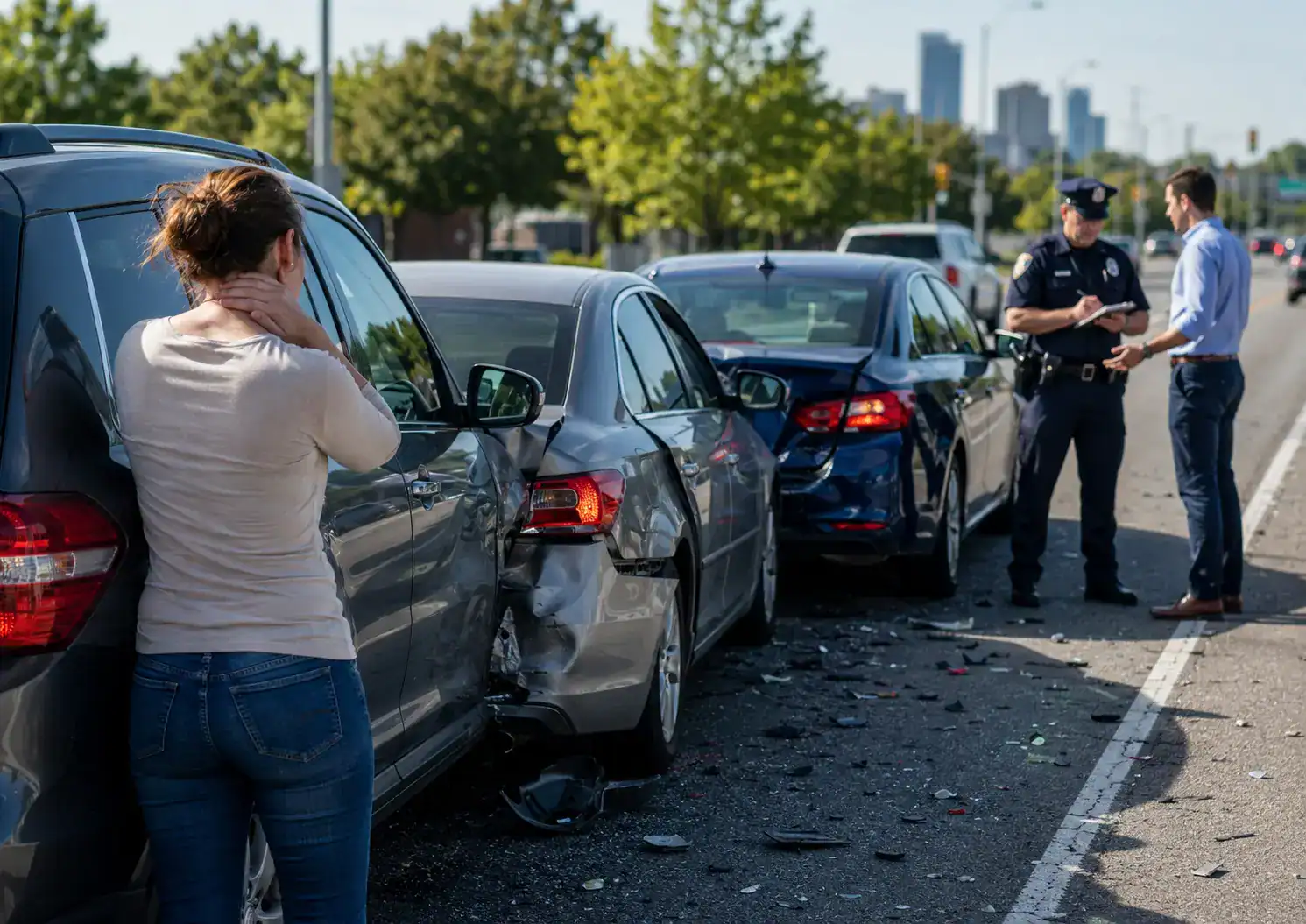
In a clean three-car example, Car C hits Car B, and the force pushes Car B into Car A. Car C’s insurer may owe for Car B’s injuries, Car A’s injuries, and both vehicles’ damage. In a disputed example, Car B may have already tapped Car A before Car C arrived. Then Car B and Car C may both share liability. That is why a chain-reaction car accident claim usually needs more investigation than a normal two-car rear-end collision.
Why Chain-Reaction Crashes Are Different From Ordinary Rear-End Crashes
A standard rear-end crash usually turns on one question: did the rear driver fail to stop in time? A chain-reaction crash adds more questions because there may be several impacts, several fault theories, and several insurance policies. The first impact may not be the only impact that caused injury. A second or third impact can worsen neck injuries, back injuries, concussions, or vehicle damage.
Insurance companies use that complexity to reduce payouts. One carrier may argue another driver started the chain. Another may argue your injuries came from a different impact. Your own insurer may say you have not exhausted the other drivers’ policies. Meanwhile, medical bills and lost wages continue while the companies argue among themselves.
For injured drivers and passengers, the important point is that complexity does not erase liability. Illinois law can assign fault to one driver or divide responsibility among multiple drivers. A well-documented claim should identify every responsible party, every applicable policy, and every category of loss before settlement talks begin.
How Illinois Law Assigns Fault in a Multi-Car Pileup
Illinois law requires drivers to keep enough distance to stop safely. Under 625 ILCS 5/11-710, a driver must not follow another vehicle more closely than is reasonable and prudent, considering vehicle speed, traffic, and highway conditions. In plain English, drivers must leave enough room for ordinary traffic changes, sudden stops, weather, and congestion.
That rule matters in a chain reaction because the final vehicle often starts the sequence by following too closely or failing to react. If traffic ahead slows and the rear driver cannot stop, the rear driver may be liable for the impact and the downstream damage. The same principle can apply to any driver in the sequence who did not leave enough stopping distance.
Illinois also uses modified comparative negligence. Under 735 ILCS 5/2-1116, a plaintiff’s recovery is reduced by their percentage of fault, and a plaintiff who is more than 50% at fault cannot recover. In a chain-reaction case, this means fault percentages matter. A person who is 10% at fault can still recover 90% of proven damages. A person who is 51% at fault cannot recover from the other driver.
Who Pays If You Were the Middle Car?
If you were the middle car in a chain-reaction accident, you are not automatically at fault just because your vehicle hit the car in front of you. The key question is whether you were pushed forward by the rear impact or whether you caused an independent impact before being struck.
Imagine you are stopped behind another car at a red light. A third vehicle slams into your rear bumper and pushes you into the first car. In that situation, you may have claims for your own injuries and vehicle damage, and the front driver may also have a claim against the rear driver. Your vehicle hitting the car ahead is part of the force chain, not proof that you drove negligently.
Now imagine you rear-end the front car first, then another driver rear-ends you seconds later. That is a different case. You may be responsible for the first impact, while the rear driver may be responsible for the second impact and any injury or damage caused by it. Small timing details can change the entire insurance analysis, which is why physical evidence and witness statements are so important.
When Multiple Drivers Share Liability
More than one driver can pay after a chain-reaction car accident in Illinois. Multi-driver liability often comes up when two or more drivers made separate mistakes that contributed to the pileup.
For example, Driver D may be texting and fail to notice traffic slowing ahead. Driver D hits Driver C. Driver C, who had been tailgating Driver B, has too little space to absorb the impact and crashes harder into Driver B. Driver B is then pushed into Driver A. In that kind of case, Driver D may be primarily responsible, but Driver C may also share fault if their close following distance made the injuries or damage worse.
| Common Scenario | Who May Pay | Evidence That Matters |
| Rear car hits middle car and pushes it forward | Rear driver’s liability insurer | Vehicle positions, rear damage, front damage, witness statements, dashcam footage |
| Middle car hit front car first, then was rear-ended | Middle driver for first impact; rear driver for second impact | Impact timing, occupant statements, damage severity, event data, police diagram |
| Several drivers were speeding or following too closely | Multiple drivers by percentage of fault | Crash reconstruction, skid marks, traffic cameras, phone records, road conditions |
| At-fault driver has too little coverage for everyone | At-fault policy plus injured person’s UIM coverage if available | Policy limits, medical bills, wage loss proof, settlement allocation among claimants |
What Insurance Coverage Applies After a Chain-Reaction Accident?
Several types of insurance can matter after a multi-car pileup. The most important is bodily injury liability coverage from the driver or drivers who caused the crash. Illinois minimum auto insurance requirements are relatively low. The Illinois Department of Insurance auto insurance guide explains that Illinois law requires at least $25,000 per person and $50,000 per accident for bodily injury liability, plus $20,000 for property damage liability. Serious chain-reaction crashes can exceed those limits quickly.
Collision coverage can pay for your vehicle repairs regardless of fault, subject to your deductible. Your insurer may then seek reimbursement from the at-fault driver’s insurer through subrogation. Medical payments coverage, if you purchased it, may help with immediate medical bills while the liability claim is pending.
Uninsured motorist and underinsured motorist coverage can also become important. The IDOI explains that uninsured motorist bodily injury coverage applies when the at-fault driver has no liability insurance or is a hit-and-run driver. Underinsured motorist coverage can apply when your UIM limits are higher than the at-fault driver’s liability limits. In a chain-reaction accident with multiple injured people, this coverage can be the difference between a partial recovery and a more complete recovery.
What If the At-Fault Driver Does Not Have Enough Insurance?
Low policy limits are a major problem in chain-reaction crashes. If one driver causes a four-car pileup and several people need medical treatment, the available liability policy may have to be divided among multiple claimants. A $50,000 per-accident bodily injury limit can disappear quickly if two people go to the emergency room, one needs physical therapy, and another misses several weeks of work.
That is why every available source of coverage should be reviewed. The at-fault driver may have more than one policy. A commercial vehicle may have higher coverage. A rideshare, delivery, trucking, or company-vehicle case may involve employer liability. Your own UIM coverage may provide additional compensation if the at-fault driver’s limits are too low.
Do not assume the first insurance check is the full amount available. In multi-car accidents, early settlement offers can be designed to close your claim before you know the total policy limits, the number of claimants, or the long-term cost of your injuries.
What Evidence Proves Who Caused the Chain Reaction?
Evidence decides who pays after a chain-reaction car accident in Illinois. The more vehicles involved, the easier it is for insurers to blame someone else. Strong evidence narrows the dispute and shows the sequence clearly.
- Scene photos showing the final position of every vehicle before anything is moved.
- Close-up photos of front-end, rear-end, and side damage on each vehicle.
- Dashcam footage, traffic-camera footage, business surveillance, or doorbell-camera video.
- Witness names, phone numbers, and short written or recorded statements when possible.
- Police report number, driver statements, citations, and the crash diagram.
- Event data recorder information from vehicles when the crash is serious or fault is disputed.
- Medical records that connect your symptoms to the crash and document treatment over time.
- Repair estimates, total-loss paperwork, towing bills, rental-car receipts, and wage-loss documentation.
Illinois crash-report rules also matter. The Illinois State Police crash report page states that drivers must file a crash report when a crash causes death, bodily injury, or more than $1,500 in property damage when all drivers are insured, or more than $500 in damage when any driver is uninsured. If no officer comes to the scene, the report generally must be filed within 10 days.
What If the Police Report Gets the Sequence Wrong?
A police report is important, but it is not the final word. Officers usually arrive after the crash. They rely on driver statements, visible damage, road conditions, and witness accounts. In a fast-moving pileup, an officer may not know whether the middle car hit first or was pushed forward.
If the report is incomplete or inaccurate, you can use other evidence to challenge it. Dashcam footage may show the entire sequence. A witness may confirm that your vehicle was stopped before impact. Damage patterns may show whether one impact was stronger than another. In serious cases, an accident reconstruction expert can analyze crush damage, momentum transfer, skid marks, roadway geometry, and electronic data.
The goal is not simply to argue with the police report. The goal is to build a clearer factual record than the insurance company is using. If the report hurts your claim, act quickly before vehicles are repaired, video is overwritten, and witnesses become harder to find.
How Insurance Companies Handle Chain-Reaction Claims
Insurance companies often handle chain-reaction claims by delaying, dividing, and discounting. They delay while they “investigate liability.” They divide responsibility among other drivers. They discount your claim by arguing that only part of your injury came from their insured’s impact.
You may hear arguments like: “our driver only caused the second impact,” “the middle vehicle was too close,” “your injuries were pre-existing,” “you did not treat quickly enough,” or “we need to wait for the other carriers to decide fault.” Some of those issues may be legitimate. Others are pressure tactics. Either way, you should not settle until the sequence, coverage, injuries, and damages are fully understood.
A practical example helps. Suppose your medical bills are $28,000, your lost wages are $6,500, and your vehicle is a total loss. If there are four claimants and one minimum policy, the insurer may try to allocate only a small portion to you. If another driver also contributed or your own UIM coverage applies, accepting that small allocation too early may leave compensation on the table.
What Should You Do Immediately After a Multi-Car Pileup?
The first step is safety. Move out of traffic if you can do so safely, call 911, and get medical help for anyone who may be injured. After that, protect the evidence.
- Do not argue about fault at the scene. Give factual information to police and avoid guessing.
- Photograph every vehicle, not just yours. Capture where each vehicle stopped after the crash.
- Get insurance, plate, driver’s license, and contact information for every driver.
- Ask witnesses what they saw and save their contact information before they leave.
- Look for nearby traffic cameras, business cameras, doorbell cameras, or dashcams.
- Seek medical care promptly, even if pain feels manageable at first.
- Notify your own insurer, but keep early statements short and factual.
- Do not sign a release or accept a settlement before you know the full extent of your injuries.
For a broader step-by-step guide, see what to do after a car accident in Chicago. The same evidence principles apply in a multi-car crash, but the need for fast documentation is even greater because several insurance companies may begin building competing versions of the event immediately.
What Damages Can You Recover After a Chain-Reaction Crash?
If another driver’s negligence caused your injuries, you may be able to recover economic and non-economic damages. Economic damages include medical bills, ambulance charges, diagnostic imaging, surgery, physical therapy, prescriptions, lost wages, reduced earning capacity, vehicle damage, towing, rental-car costs, and out-of-pocket expenses.
Non-economic damages include pain and suffering, emotional distress, loss of normal life, disfigurement, disability, and the way the crash changes your daily routine. For example, a person with a herniated disc may face months of treatment, work restrictions, sleep disruption, and limits on lifting, driving, or caring for family members. Those losses matter even when they do not appear as a neat line item on a bill.
Damages should not be calculated from medical bills alone. A complete demand should account for future treatment, permanent symptoms, missed overtime, lost promotions, household help, transportation costs, medical liens, health-insurance reimbursement claims, and the stress of dealing with several insurers at once.
How Long Do You Have to File a Chain-Reaction Accident Claim in Illinois?
Most Illinois personal injury claims must be filed within two years of the accident under 735 ILCS 5/13-202. Property-damage claims are generally subject to a five-year limitation period under 735 ILCS 5/13-205. These deadlines sound longer than they feel because evidence can disappear within days or weeks.
Insurance notice deadlines may be shorter than court filing deadlines. Your policy may require prompt notice, cooperation, medical documentation, proof of loss, or UM/UIM procedures. If the crash involves a government vehicle, public entity, or roadway defect, different notice and filing rules may apply. Get advice quickly when more than ordinary private-driver liability is involved.
Get Help With a Chain-Reaction Car Accident Claim in Illinois
If you were injured in a multi-car pileup, do not let several insurance companies decide fault without your side of the evidence. The Law Offices of John S. Eliasik handles Illinois motor vehicle accident claims involving disputed liability, serious injuries, low policy limits, uninsured or underinsured drivers, and complex crash sequences.
For a free case evaluation, contact The Law Offices of John S. Eliasik. We can review the police report, identify all available insurance coverage, preserve evidence, deal with the adjusters, and help determine who should pay after your chain-reaction car accident in Illinois.
FAQs
Who pays after a chain-reaction car accident in Illinois if I was the middle car?
Usually, the driver who started the chain reaction pays through their liability insurance if their impact pushed your vehicle into the car ahead. You are not automatically at fault just because your car made contact with another vehicle. The evidence must show whether you were pushed forward or caused a separate impact first.
Can more than one driver be responsible for a chain-reaction crash?
Yes. Multiple drivers can share fault if more than one negligent action contributed to the crash. One driver may have been distracted, another may have followed too closely, and another may have changed lanes unsafely. Illinois comparative negligence rules allow fault to be divided by percentage.
What if the police report says I was partly at fault?
A police report matters, but it is not the final decision. You can challenge an inaccurate report with photos, dashcam footage, witnesses, repair evidence, event data, and accident reconstruction. The earlier you preserve evidence, the easier it is to correct a bad fault narrative.
Who pays if the at-fault driver does not have enough insurance?
The at-fault driver’s liability policy pays first, but minimum limits may not be enough when several people are injured. Your own underinsured motorist coverage may apply if your UIM limits are higher than the at-fault driver’s available liability limits. Coverage depends on your policy language and the facts.
Can I use my own insurance after a chain-reaction accident?
Yes, depending on your coverage. Collision coverage may pay for vehicle damage. Medical payments coverage may help with medical bills. UM/UIM coverage may apply if the at-fault driver is uninsured or underinsured. Your insurer may later seek reimbursement from the responsible driver’s insurer.
How do you prove which impact caused an injury?
Medical records, crash timing, vehicle damage, occupant statements, and expert analysis can help connect an injury to a specific impact or to the crash sequence as a whole. In many cases, the law does not require perfect separation of every injury if the negligent conduct combined to cause harm.
Do I need a lawyer for a chain-reaction car accident in Illinois?
You should strongly consider legal help if you were injured, fault is disputed, several vehicles were involved, there are multiple insurance companies, the at-fault driver has low limits, or you are being pressured to settle quickly. Chain-reaction claims are often more complex than ordinary two-car collisions.
How long do I have to file a lawsuit after a multi-car pileup?
Most Illinois personal injury lawsuits must be filed within two years of the accident. Property-damage claims generally have a longer deadline, but insurance policies may require prompt notice much sooner. Waiting can also make evidence harder to find, so it is safer to act quickly.
Disclaimer: This article is provided by Eliasik Law for general informational purposes only and does not constitute legal advice. Reading this content does not create an attorney-client relationship. Laws, fees, regulations, and court decisions referenced may change. For advice on your specific situation, please contact Eliasik Law directly to schedule a consultation.