
Table of Contents
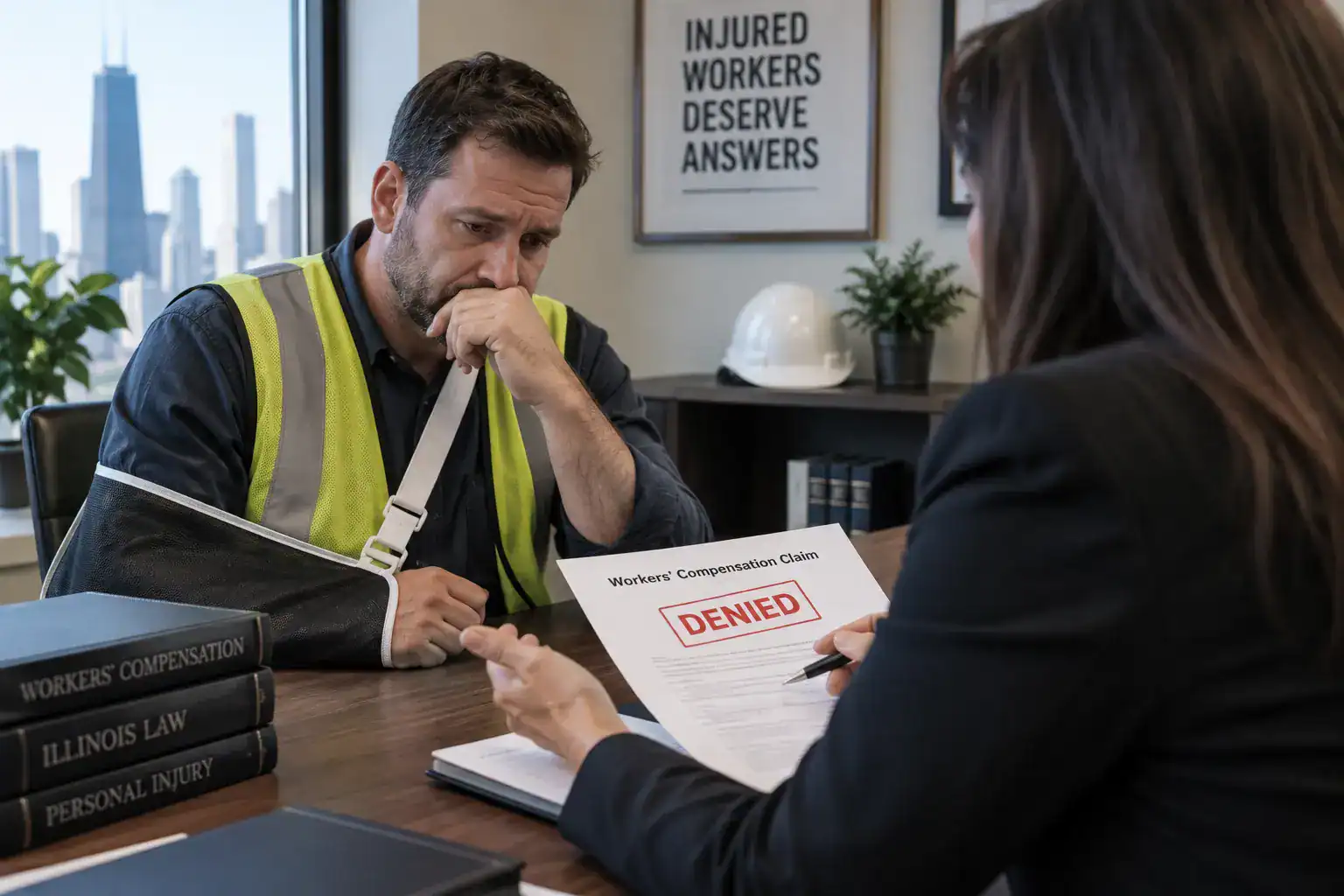
Denied Workers’ Comp Claims in Illinois, the short answer is yes, claims can be denied. Illinois employers and their insurance carriers deny workers’ compensation claims every day, even legitimate ones. If you’ve been hurt on the job and your claim was denied, you’re not out of options. Illinois law gives you clear appeal rights and deadlines, and many denied workers’ comp claims in Illinois get reversed when workers fight back with the right evidence and legal help.
This article explains why claims get denied in Illinois, what the denial notice means, how to appeal, what evidence strengthens your case, and when you should talk to a workers’ comp attorney.
Key Takeaways
- Insurance carriers deny workers’ comp claims in Illinois for reasons including missed deadlines, disputes over whether the injury is work-related, lack of medical evidence, or claims that you were intoxicated or violated safety rules.
- You have the right to appeal a denial by requesting a hearing before an arbitrator at the Illinois Workers’ Compensation Commission (IWCC).
- The denial notice must state the specific reason for the denial, and you typically have three years from the date of injury to file your case at the IWCC, though acting quickly is always better.
- Medical records, witness statements, and employer incident reports are critical evidence, and gaps or inconsistencies can be used against you.
- An experienced Illinois workers’ compensation attorney can help you gather evidence, meet deadlines, and challenge the insurance company’s decision at every stage.
Why Insurance Carriers Deny Workers’ Comp Claims in Illinois
Insurance carriers and employers deny workers’ comp claims for many reasons, some legitimate and others not. Understanding the most common grounds for denial helps you spot problems early and respond effectively.
Missed Reporting Deadlines
Illinois law requires you to notify your employer of a work injury as soon as practical, and no later than 45 days after the accident. If you wait too long to report the injury, the carrier may deny your claim on the grounds that you didn’t give timely notice. There are exceptions, such as when you didn’t immediately realize the injury was serious, but late reporting is one of the easiest ways for a carrier to deny benefits.
Dispute Over Whether the Injury Is Work-Related
The insurance company may argue that your injury didn’t happen at work or didn’t arise out of your employment. This is common in cases involving:
- Injuries that develop gradually, like carpal tunnel or back problems
- Pre-existing conditions that worsened on the job
- Injuries that occurred during breaks, off-site, or while traveling
- Claims where there were no witnesses
Carriers often deny claims first and force the worker to prove the connection at a hearing.
Insufficient Medical Evidence
If you didn’t see a doctor right away, or if your medical records don’t clearly link your injury to a work incident, the carrier may deny the claim. They may also dispute the severity of your injury or argue that you’re able to return to work when your doctor says otherwise.
Allegations of Intoxication or Drug Use
Illinois law allows a carrier to deny a claim if they can prove that intoxication or illegal drug use was the sole proximate cause of the injury. Employers sometimes request drug or alcohol testing after an accident. A positive test alone doesn’t automatically disqualify you, but it gives the carrier ammunition to challenge your claim.
Safety Violations or Horseplay
If the employer claims you were injured while violating a safety rule, engaging in horseplay, or acting outside the scope of your job, they may deny coverage. These defenses are harder to prove than many employers think, but employers raise them regularly.
Pre-Existing Conditions
Carriers frequently deny claims when you have a prior injury or condition affecting the same body part. Under Illinois law, you’re still entitled to benefits if your work aggravated, accelerated, or combined with the pre-existing condition to cause a disability. But expect the insurance company to fight this.
Incomplete or Inconsistent Accident Reports
If your description of how the injury happened changes between your initial report, your medical visits, and your claim forms, the carrier will use those inconsistencies to argue that the injury isn’t credible or work-related.
What a Denial Notice Means Under Illinois Law
When the insurance carrier denies your claim, they must send you a written notice explaining the reason. This notice is required under Illinois Workers’ Compensation Commission rules. The denial may come in the form of a formal letter or a “denial of compensability” filed with the IWCC.
The notice should identify the specific legal or factual basis for the denial. Common language includes:
- “Injury did not arise out of and in the course of employment”
- “Untimely notice to employer”
- “Causal connection not established”
- “Intoxication was the proximate cause”
Read the denial carefully. The reason stated determines what evidence you’ll need to overcome it.
A denial doesn’t mean your case is over. It means the carrier is refusing to pay voluntarily, and you’ll need to pursue your claim through the IWCC’s dispute resolution process.
Your Right to Appeal Denied Workers’ Comp Claims in Illinois
Illinois gives injured workers a clear path to challenge a denial: you file an Application for Adjustment of Claim with the Illinois Workers’ Compensation Commission. This starts the formal dispute process.
The Illinois Workers’ Compensation Commission (IWCC)
The IWCC is the state agency that handles workers’ comp disputes. It operates independently of your employer and the insurance company. Once you file your application, the IWCC assigns your case to an arbitrator who will hold hearings, review evidence, and issue a written decision.
Deadlines to File Your Claim
You generally have three years from the date of your accident to file your Application for Adjustment of Claim. For occupational diseases or repetitive trauma injuries, the timeline may be measured differently. If your claim involves a fatality, dependents typically have three years from the date of death or two years from the last payment of compensation, whichever is later.
Don’t wait until the deadline approaches. Evidence gets stale, witnesses move on, and delays hurt your credibility.
What Happens After You File
Once you file your application:
- The case goes to mandatory mediation (called a “pre-trial conference”) to see if the parties can settle.
- If the parties reach no settlement, the case proceeds to an arbitration hearing where both sides present evidence and witnesses.
- The arbitrator issues a written decision, which either side can appeal to the IWCC’s full Commission and then to the Illinois courts.
You can represent yourself, but insurance companies have lawyers and adjusters who do this every day. Going it alone puts you at a serious disadvantage.
Steps to Take After the Carrier Denies Your Claim
When you receive a denial, take these steps as soon as possible:
Review the Denial Letter Carefully
Identify the specific reason given. If the letter is vague or confusing, don’t ignore it, get help interpreting what it means and what evidence you’ll need.
Gather All Documentation
Collect:
- The accident or incident report you filed with your employer
- All medical records, including emergency room visits, doctor’s notes, diagnostic tests, and treatment plans
- Witness statements or contact information for co-workers who saw the accident
- Photos of the accident scene, your injuries, or hazardous conditions
- Correspondence with your employer or the insurance carrier
- Pay stubs and records of lost wages
Get Medical Treatment and Follow Your Doctor’s Orders
Continue treating with your doctor. Gaps in treatment give the insurance company a reason to argue that your injury isn’t serious or that you’ve recovered. Keep all appointments and follow your treatment plan.
If the carrier denied your claim, you may need to use your health insurance or pay out of pocket temporarily. Keep all receipts and billing statements, you can seek reimbursement if you win your case.
Don’t Give Recorded Statements Without Legal Advice
Insurance adjusters may contact you after a denial and ask for another statement. Be cautious. Anything you say can be used to undermine your claim. You’re not required to give a statement to the carrier’s lawyer or investigator once your claim is disputed.
File Your Application for Adjustment of Claim
Don’t assume the denial will go away on its own. File your application with the IWCC to preserve your rights and start the hearing process.
Talk to an Illinois Workers’ Compensation Attorney
An attorney who focuses on workers’ comp can review the denial, identify weaknesses in the carrier’s position, gather the evidence you need, and represent you at hearings. Most workers’ comp attorneys work on contingency, meaning you don’t pay attorney fees unless you win.
Evidence That Strengthens Your Appeal of Denied Workers’ Comp Claims in Illinois
To overturn a denial, you’ll need to prove your case by a preponderance of the evidence, meaning it’s more likely than not that your injury is work-related and compensable. Strong evidence makes the difference.
Medical Records That Clearly Link Your Injury to Work
Your treating doctor’s notes should describe:
- Your account of how the injury happened
- Objective findings (swelling, reduced range of motion, imaging results)
- A diagnosis
- A statement that the injury is consistent with the work incident you described
If your doctor’s records are vague or don’t mention work, ask your doctor to provide a supplemental report or letter clarifying the connection.
Employer Incident Reports
If you filed an accident report with your employer, that document is powerful evidence that you reported the injury promptly and consistently. If your employer didn’t document the incident, witness testimony becomes even more important.
Witness Statements
Co-workers who saw your accident or heard you report your injury right away can corroborate your story. Written statements or testimony at a hearing can counter the carrier’s claim that the injury didn’t happen at work.
Timely Medical Treatment
Seeking medical care immediately after the injury, or as soon as symptoms appeared, strengthens your credibility. Delays raise questions about whether the injury is serious or work-related.
Consistent Descriptions of the Accident
Make sure your account of how the injury occurred is consistent across your employer report, medical records, and testimony. Even small inconsistencies will be used against you.
Expert Medical Testimony
In disputed cases, you may need an independent medical examination (IME) or expert testimony from a doctor who can explain how your work caused or aggravated your condition. Carriers often hire their own IME doctors to dispute your claim, so having your own medical expert can level the playing field.
Common Mistakes That Hurt Your Appeal
Injured workers often make avoidable mistakes that weaken their case or even result in a loss at hearing.
Waiting Too Long to Act
The longer you wait to file your application or gather evidence, the harder it becomes to prove your case. Witnesses forget details, records get lost, and your credibility suffers.
Failing to Follow Up With Medical Treatment
Gaps in your medical records suggest to the arbitrator, and the insurance company, that you’re not really hurt or that you’ve recovered. Keep treating until your doctor releases you.
Posting on Social Media
Photos or posts that show you doing physical activities, even normal daily tasks, can be taken out of context and used to argue that you’re not as injured as you claim. Be mindful of what you share online while your case is pending.
Giving Inconsistent Statements
Even minor differences in how you describe the accident can be used to challenge your credibility. Stick to the facts and be consistent.
Returning to Work Too Soon
If you go back to work before your doctor clears you, the carrier may argue that you’re no longer disabled. Don’t let your employer or the insurance company pressure you into returning before you’re medically ready.
Not Hiring an Attorney
Workers who try to handle their own IWCC hearings are up against experienced insurance defense lawyers. The process involves rules of evidence, legal procedure, and strategy that most people aren’t familiar with. An attorney improves your odds significantly.
How an Attorney Can Help With Denied Workers’ Comp Claims in Illinois
A workers’ compensation attorney does much more than just show up at a hearing. Here’s how the right lawyer can turn around denied workers’ comp claims in Illinois:
Investigate the Denial and Identify the Weaknesses
An experienced attorney knows how to analyze the carrier’s denial, spot holes in their argument, and build a case that addresses the specific reason for the denial.
Gather and Organize Evidence
Your lawyer can obtain medical records, track down witnesses, work with your doctors to get the right reports, and secure expert testimony when needed.
Handle All Filings and Deadlines
The IWCC has strict procedural rules and deadlines. Missing a filing deadline or failing to serve documents properly can hurt or even end your case. Your attorney manages the process so nothing falls through the cracks.
Negotiate a Settlement
Many denied claims eventually resolve through settlement. An attorney knows the value of your case and can negotiate with the insurance company from a position of strength.
Represent You at Hearings
At arbitration, your lawyer will present your evidence, question witnesses, cross-examine the carrier’s witnesses, and argue your case to the arbitrator. This is where legal skill makes the biggest difference.
Appeal an Unfavorable Decision
If you lose at arbitration, your attorney can appeal the decision to the full Commission and, if necessary, to the Illinois appellate courts.
What Benefits You Can Recover if Your Appeal Succeeds
If you win your case at the IWCC, you’re entitled to the benefits that Illinois law provides for work injuries, which may include:
- Medical expenses: All reasonable and necessary medical treatment related to your work injury, including doctor visits, surgery, physical therapy, prescriptions, and medical equipment.
- Temporary total disability (TTD): Wage replacement benefits while you’re off work and recovering, typically two-thirds of your average weekly wage, subject to a statutory cap.
- Temporary partial disability (TPD): Partial wage benefits if you return to work at reduced hours or reduced pay while you’re still recovering.
- Permanent partial disability (PPD): Compensation for permanent impairment or loss of use of a body part, calculated based on the nature and extent of your injury.
- Permanent total disability (PTD): Ongoing wage replacement if your injury prevents you from ever returning to the workforce.
- Vocational rehabilitation: Services to help you return to work if you can’t do your old job.
Your attorney will calculate the full value of your claim and fight to recover every benefit you’re entitled to under Illinois law.
How Long Does the Appeal Process Take?
The timeline varies depending on the complexity of your case, the court’s schedule, and whether the parties reach a settlement. Here’s a general outline:
- Filing to first pre-trial: Typically a few months
- Mediation and settlement negotiations: Can last weeks to months
- Arbitration hearing: May occur 6, 12 months or more after filing, depending on the court’s docket
- Arbitrator’s decision: Usually issued within a few months of the hearing
- Appeals: Can add another year or more if the case goes to the Commission or appellate court
If your claim is straightforward and the evidence is strong, settlement can happen relatively quickly. Complex or contested cases take longer, but waiting for a fair outcome is better than accepting a lowball settlement or giving up.
We Fight Denied Workers’ Compensation Claims in Illinois
If the insurance carrier denied your workers’ compensation claim, you don’t have to accept the insurance company’s decision. At Eliasik Law, we represent injured workers throughout Illinois in disputes with employers and insurance carriers. Our firm’s founder spent years working defense-side for a major insurer, so we know how the other side thinks and what it takes to win at the IWCC.
We handle workers’ comp cases on a contingency basis, you don’t pay attorney fees unless we win. We offer free consultations, and we’ll review your denial, explain your options, and help you fight back.
If you’ve been hurt on the job and the carrier denied your claim, contact Eliasik Law today. We’re here to help you get the benefits you’re owed under Illinois law.
FAQs
Can my employer fire me for filing a workers’ compensation claim in Illinois?
Illinois law prohibits retaliation against workers for filing a workers’ comp claim. If your employer fires you, demotes you, or otherwise punishes you for asserting your rights, you may have a separate legal claim for retaliatory discharge. Document the circumstances and talk to an attorney right away.
What if I missed the 45-day reporting deadline?
You may still have a claim. Illinois law requires notice “as soon as practicable,” and courts recognize exceptions when the injured worker didn’t immediately realize the injury was serious or work-related. The carrier will fight you on this, so you’ll need strong evidence and legal help.
Can I see my own doctor, or do I have to use the employer’s doctor?
In Illinois, your employer has the right to direct your initial medical treatment. If you’ve been treating with your own doctor, the carrier may refuse to pay those bills. However, once you’ve seen the employer’s doctor, you can often switch to a doctor of your choice. This is a common source of disputes, and the rules are nuanced.
What if the insurance company offers me a settlement after I appeal?
Settlement offers are common once you file a case. Before you accept, have an attorney review the offer to make sure it covers your medical expenses, lost wages, and any permanent disability. Once you settle, you generally can’t reopen the case later.
Do I have to go to an Independent Medical Examination (IME)?
If the insurance carrier requests an IME and the arbitrator orders it, you’re required to attend. The IME doctor is hired by the insurance company and will often give opinions that favor the carrier. You can challenge those opinions with your own medical evidence and testimony.
How much does it cost to hire a workers’ comp attorney?
Most Illinois workers’ compensation attorneys work on a contingency basis. Attorney fees are typically a percentage of the benefits you recover, often between 15% and 20%, and the state caps them by Illinois law. You don’t pay anything upfront, and you don’t pay attorney fees if you don’t win.
What if I have a pre-existing condition?
You’re still entitled to workers’ comp benefits if your job aggravated, accelerated, or combined with your pre-existing condition. The insurance company will try to blame everything on the pre-existing injury, but Illinois law protects workers in this situation. Strong medical evidence is critical.
Can I reopen a denied claim if I find new evidence?
In some cases, yes. If new medical evidence becomes available or you discover facts that weren’t known at the time of the denial, you may be able to reopen your claim. Timing and procedural rules apply, so talk to an attorney as soon as you learn of new evidence.
Disclaimer: This article is provided by Eliasik Law for general informational purposes only and does not constitute legal advice. Reading this content does not create an attorney-client relationship. Laws, fees, regulations, and court decisions referenced may change. For advice on your specific situation, please contact Eliasik Law directly to schedule a consultation.