
Table of Contents
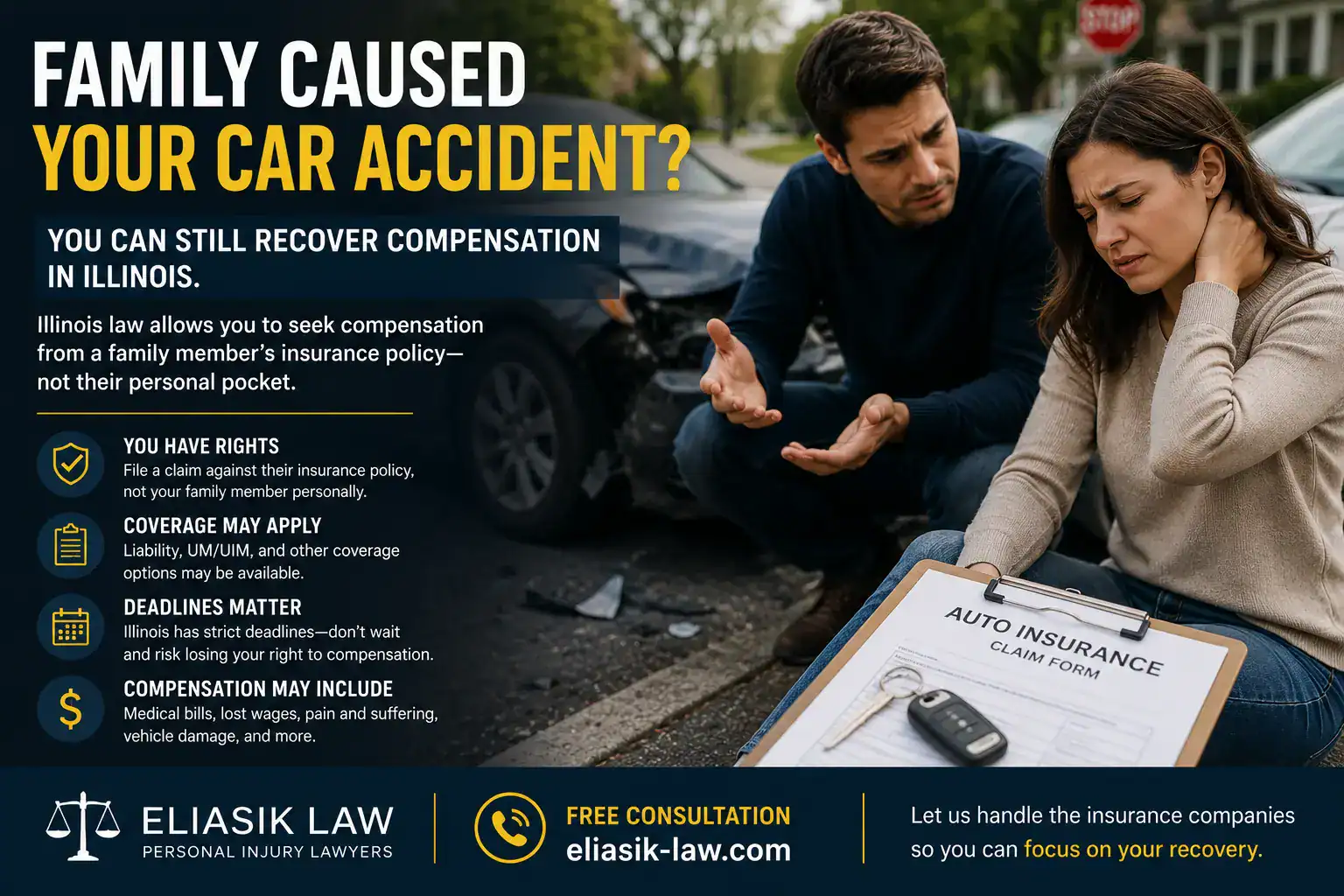
Yes. In many Illinois car accident cases, you can still seek compensation even if the at-fault driver was your spouse, parent, child, sibling, or another relative. The practical issue is usually not whether the person is family. The practical issue is which insurance policy applies, whether a household exclusion limits coverage, and whether your own UM/UIM coverage can help fill the gap.
This situation feels uncomfortable because the person who caused the crash may be someone you love. But a claim after a family-caused crash is usually an insurance claim, not an attempt to take money directly from a relative. Auto insurers collect premiums for covered accidents, including accidents caused by household members or permissive drivers when the policy provides coverage.
These cases also need careful handling. Illinois auto policies may include exclusions. The same household, same vehicle, same policy, and named-insured status can all affect the result. Before giving a recorded statement or accepting a quick offer, it is important to review the declarations page, full policy, liability limits, uninsured motorist coverage, underinsured motorist coverage, and any family-member exclusion language.
Key Takeaways
- Illinois does not automatically block compensation just because the at-fault driver was a family member. Coverage depends on the facts and policy language.
- Illinois minimum auto liability limits are $25,000 per person, $50,000 per accident, and $20,000 for property damage, which may be too low for serious injuries.
- Household exclusions can create problems when relatives are insured under the same policy, but Illinois law limits some family-exclusion applications.
- UM/UIM coverage may be important when the at-fault relative has no coverage, too little coverage, or liability coverage is disputed.
- A lawsuit may technically name the family member, but the insurance company usually controls the defense and pays covered settlements or judgments up to policy limits.
- Illinois generally gives injured people two years to file a personal injury lawsuit, but insurance policies require prompt notice, so waiting can hurt coverage and evidence.
Can You File a Claim If a Relative Caused the Crash?
You can often file a claim after a crash caused by a relative. For example, a claim may be possible if your spouse rear-ended another vehicle while you were a passenger, your adult child caused a crash while driving a separately insured vehicle, or your sibling ran a red light and injured you.
The claim usually starts with the available auto insurance, not with personal collection from the family member. The insurance carrier investigates the crash, decides whether the policy covers the loss, negotiates settlement, and pays covered damages up to the policy limit. If litigation becomes necessary, the at-fault relative may be named as the defendant because that is how liability claims are filed, but the insurer typically provides a defense when coverage applies.
That distinction matters emotionally. Many injured people avoid claims because they feel like they are “suing family.” In reality, they may be trying to access coverage that was purchased for accident-related medical bills, lost wages, and injury damages.
Why Family-Member Accident Claims Are More Complicated Than Regular Car Accident Claims
A crash caused by a stranger usually follows a clearer path: the injured person files a third-party liability claim against the at-fault driver’s insurer. Family-member accidents can involve more layers, including:
- whether the injured person and at-fault driver live in the same household;
- whether they are both named insureds or listed drivers on the same policy;
- whether the vehicle was owned by the injured person, the relative, or another household member;
- whether the policy contains a household, family, resident-relative, or intra-family exclusion;
- whether a separate policy, umbrella policy, medical payments coverage, UM coverage, or UIM coverage may apply; and
- whether the insurer is using family dynamics to pressure the injured person into dropping or undervaluing the claim.
This is why the full policy matters. A declarations page shows limits, vehicles, named insureds, and listed drivers, but exclusions and definitions are usually buried in the policy form. The difference between “named insured,” “resident relative,” “permissive user,” and “household member” can change the coverage analysis.
Illinois Auto Insurance Minimums Matter in Family-Caused Crashes
Illinois requires vehicle owners to carry minimum auto liability insurance. The Illinois Department of Insurance explains that bodily injury liability coverage must be at least $25,000 per person and $50,000 total per accident, and property damage liability coverage must be at least $20,000 per accident. The Department also warns that state minimums may not be enough to fully protect someone after a crash. Illinois Department of Insurance auto insurance shopping guide.
Those numbers are important in a family-member accident claim because policy limits are usually the ceiling for what one policy will pay. A single emergency room visit, imaging, physical therapy, lost income, and pain symptoms can exceed a minimum-limit policy quickly.
Example: Assume your sister causes a crash while driving her own car, and she has Illinois minimum bodily injury limits of $25,000 per person. Your medical bills are $18,500, you miss $4,200 in wages, and your doctor expects another $9,000 in therapy and follow-up care. Before pain and suffering are even considered, the economic losses are already $31,700. If no additional coverage exists, the available liability policy may be too low to fully compensate you.
How Household Exclusions Can Affect Recovery
A household exclusion is policy language that attempts to exclude or limit bodily injury coverage when the injured person is a family member, resident relative, or insured under the same policy. These exclusions are one of the biggest coverage issues in family-caused car accidents.
Illinois law does not make every family exclusion automatically valid in every situation. For example, 215 ILCS 5/143.01 says certain vehicle-policy family exclusions are not applicable when a third party acquires a right of contribution against a member of the injured person’s family, and they are not applicable when a person who is not in the insured’s household was driving the insured vehicle involved in the crash.
That does not mean every family claim is covered. It means a denial letter based on a household or family exclusion should not be accepted at face value. The exact policy language, driver’s residence, vehicle ownership, policyholder status, and relationship between the parties must be reviewed.
Common Coverage Scenarios After a Family-Member Crash
| Scenario | Likely Coverage Question | Why It Matters |
| Spouse causes crash while both spouses are on the same policy | Does a household or family-member exclusion apply? | The liability policy may deny or limit coverage, so UM/UIM, med-pay, or other coverage must be reviewed. |
| Adult child living elsewhere causes the crash in their own car | Does the adult child have separate liability coverage? | This may look more like a standard third-party claim if the injured parent is not insured under that policy. |
| Relative borrows your car and causes a crash that injures you | Does your policy cover permissive drivers, and does an exclusion apply? | Illinois coverage often starts with the vehicle policy, but policy language controls. |
| Family member has no insurance | Does your own uninsured motorist coverage apply? | UM coverage may help when the at-fault driver has no liability insurance, but the policy must be reviewed. |
| Family member has low limits and injuries are serious | Is underinsured motorist coverage or umbrella coverage available? | UIM can matter when the at-fault driver’s limits are lower than your UIM limits and damages exceed the liability policy. |
Can Your Own UM/UIM Coverage Help?
Your own auto policy may be important even when the crash was caused by a family member. The Illinois Department of Insurance defines uninsured motorist bodily injury coverage as coverage for bodily injury caused by a hit-and-run driver or an at-fault driver with no auto liability insurance. Illinois minimum UM limits are currently $25,000 per person and $50,000 per accident. IDOI auto insurance definitions.
Underinsured motorist coverage is different. IDOI explains that UIM pays the difference between your UIM limits and the at-fault driver’s liability limits if the at-fault driver’s limits are lower than your UIM limits. Illinois law requires UIM coverage if you buy higher UM limits. IDOI UM/UIM explanation.
This means UM/UIM coverage should be analyzed carefully, but it should not be oversold. A household exclusion denial does not automatically mean UM or UIM will pay. Your own policy may have definitions, exclusions, notice requirements, arbitration clauses, and limits that affect the claim. A lawyer reviews both the relative’s policy and your own policy before deciding the best path.
Example: Your parent causes a crash while driving a vehicle with $25,000/$50,000 bodily injury limits. You have $100,000/$300,000 UM/UIM coverage on your own policy. If your injury damages are worth more than the liability limit and your policy conditions are met, UIM may become a key source of additional recovery. If a household exclusion is involved, the analysis becomes more complex and needs a close legal review.
What Damages Can You Recover?
When coverage applies, the types of compensation are generally the same as in other Illinois car accident cases. Depending on the evidence, injuries, and policy limits, a claim may include:
- Medical expenses: emergency care, hospitalization, surgery, orthopedic treatment, physical therapy, imaging, medication, injections, and follow-up care.
- Future medical care: expected treatment, future therapy, pain management, surgery, assistive devices, or specialist care.
- Lost wages: missed shifts, lost salary, used PTO, missed overtime, and reduced earnings during recovery.
- Loss of earning capacity: reduced ability to perform your previous job, accept overtime, do physical work, or return to the same career path.
- Property damage: vehicle repair, total-loss value, rental expenses, towing, and personal property damaged in the crash.
- Pain and suffering: physical pain, sleep disruption, emotional distress, inconvenience, loss of enjoyment of life, and permanent limitations.
The biggest mistake is settling before the medical picture is clear. Once you sign a release, the claim is usually over. If your neck injury later turns out to involve a herniated disc, nerve symptoms, or long-term therapy, you generally cannot reopen the same settled claim.
Does Filing a Claim Mean You Are Personally Suing Your Family Member?
Not always at the beginning. Many claims start with insurance negotiations. The injured person or attorney opens a claim, sends medical records and evidence, negotiates with the adjuster, and attempts to settle within available coverage. The at-fault relative may cooperate by confirming what happened and providing policy information.
If the insurance company denies coverage, refuses to offer fair value, or the statute of limitations is approaching, a lawsuit may become necessary. In that situation, the family member may technically be named as a defendant because Illinois personal injury lawsuits are filed against the allegedly negligent person or entity. But where coverage applies, the insurer usually hires defense counsel and pays covered settlements or judgments up to the policy limits.
The possibility of an excess judgment should be discussed with a lawyer. If damages exceed coverage, there can be personal-exposure issues. That is another reason to identify all insurance sources early, including liability coverage, UM/UIM coverage, umbrella coverage, med-pay coverage, and any other available policies.
What If the Relative Was Driving Your Car?
If a relative was driving your vehicle with permission, the policy covering the vehicle is often the first place to look. IDOI explains that liability coverage may pay if an accident was caused by a family member living with you or a person using your vehicle with your permission. It also warns that household driving information matters and that withholding it may jeopardize coverage. IDOI auto insurance shopping guide.
But this still depends on policy terms. Some policies exclude certain drivers, limit coverage for household members who were not disclosed, or handle resident relatives differently from occasional permissive users. If the relative was specifically excluded from the policy, coverage may be denied. If the relative had separate insurance, that policy may also need to be reviewed.
What If the At-Fault Family Member Is a Minor?
A minor usually does not have their own separate auto policy unless they are listed under a parent or household policy. If a minor relative caused the crash, the claim may involve the vehicle owner’s policy, the parent’s policy, or another household policy. The key questions are who owned the vehicle, who insured it, whether the minor had permission, and whether the policy covered that minor driver.
In serious cases, additional questions can arise about negligent entrustment, supervision, or whether the adult owner knew the minor was unsafe, unlicensed, or not allowed to use the vehicle. Those theories are fact-specific and should be evaluated carefully before a claim is framed.
What If the Insurer Says a Household Exclusion Blocks the Claim?
A denial letter is not always the final answer. Insurance companies may cite broad exclusion language and hope the injured person walks away. Before accepting the denial, review:
- the exact exclusion language;
- who is defined as “insured,” “family member,” “resident relative,” and “household member”;
- whether the injured person and at-fault driver lived together at the time of the crash;
- whether the at-fault driver was a named insured, listed driver, excluded driver, or permissive user;
- whether Illinois law limits the exclusion in that specific scenario;
- whether UM, UIM, med-pay, umbrella, or another policy may still provide coverage; and
- whether the insurer complied with Illinois insurance claim obligations and explained its denial clearly.
A strong attorney response often asks for the full policy, declarations page, endorsements, denial basis, recorded-statement transcripts, claim notes, and coverage position in writing.
How Comparative Negligence Can Affect a Family-Member Crash Claim
Illinois uses modified comparative negligence. IDOI explains that an injured person may recover damages only if they are less than 50% at fault, and any recovery may be reduced in proportion to their share of fault. Illinois comparative negligence guidance.
In a family-caused crash, the insurer may argue that you contributed to the collision or increased your injuries. For example, an adjuster may argue that you distracted the driver, grabbed the wheel, failed to warn the driver, delayed treatment, or gave an inconsistent statement. These arguments do not automatically defeat a claim, but they can reduce settlement value if not answered with evidence.
Evidence that helps includes the police report, photos, witness statements, dashcam footage, vehicle damage, medical records, 911 records, repair estimates, and consistent statements about how the crash happened.
Do Seat Belts Affect Recovery in Illinois?
Illinois requires drivers and passengers to wear properly adjusted and fastened seat belts, but the legal effect in an injury claim is important. Under 625 ILCS 5/12-603.1, failure to wear a seat belt shall not be considered evidence of negligence, shall not limit insurer liability, and shall not diminish recovery for damages arising from the ownership, maintenance, or operation of a motor vehicle.
That means a seat-belt issue should not be casually treated as comparative fault in an Illinois car accident claim. If an insurer tries to reduce a claim based on seat-belt use, the response should point directly to Illinois law.
Steps to Take After a Family-Member-Caused Car Accident
- Get medical care right away. Do not avoid treatment because the driver was family. Medical records connect your injuries to the crash.
- Report the accident. If police respond, request the report number. If they do not, document the date, time, location, vehicles, and people involved.
- Take photos and preserve evidence. Photograph vehicle damage, the scene, license plates, road conditions, injuries, insurance cards, and any visible hazards.
- Do not make informal promises. Avoid saying “I will not file a claim” or “I am fine” before you know the medical and insurance facts.
- Notify insurance promptly. Most policies require prompt notice, but do not give a recorded statement without understanding how it may affect coverage.
- Request every relevant policy. Ask for the full policy, declarations page, endorsements, UM/UIM limits, med-pay limits, and any exclusion language.
- Track every dollar. Keep medical bills, wage records, receipts, mileage, prescriptions, therapy notes, and proof of missed work.
- Talk to a lawyer before accepting money. A quick settlement may close the claim before you know whether surgery, injections, therapy, or lost-income issues will continue.
How Much Could a Family-Member Accident Claim Be Worth?
There is no automatic value based on the relationship. The claim value depends on injury severity, medical treatment, fault evidence, policy limits, coverage defenses, lost income, long-term limitations, and whether multiple policies are available.
Example 1: A passenger suffers a minor soft-tissue injury after a low-speed crash caused by a relative with separate insurance. Treatment lasts six weeks and the medical bills are modest. The claim may resolve within liability limits if coverage is clear.
Example 2: A spouse causes a serious highway crash while both spouses are on the same household policy. The injured spouse needs surgery and misses months of work. A household exclusion is raised. The case may require policy analysis, UM/UIM review, medical documentation, and possibly litigation before the available recovery sources are clear.
Example 3: An adult child with minimum insurance causes a crash that leaves a parent with a herniated disc and permanent restrictions. If the damages exceed $25,000, the parent’s own UIM coverage may become critical if the policy requirements are satisfied.
How Long Do You Have to File a Claim?
For most Illinois personal injury lawsuits, the statute of limitations is generally two years from the date the claim accrues. The Illinois personal injury statute is 735 ILCS 5/13-202. However, insurance policies usually require prompt notice, and waiting can make it harder to prove injuries, preserve vehicle evidence, gather witness statements, and secure coverage.
Do not wait two years to start the insurance process. A family relationship does not stop the legal clock, and an insurer may use delay to argue that injuries were not serious, records are missing, or coverage conditions were violated.
Get Help With a Family-Member Car Accident Claim in Illinois
A crash caused by a relative can create a difficult mix of injury, money, insurance, and family pressure. You do not have to sort through policy exclusions, UM/UIM coverage, adjuster tactics, and settlement value alone. Contact The Law Offices of John S. Eliasik for a free case evaluation and find out what insurance options may be available after an Illinois car accident caused by a family member.
FAQs
Can you recover compensation if a family member caused your car accident in Illinois?
Yes, in many cases. Illinois does not automatically bar a claim because the at-fault driver was a relative. The key issues are which policy applies, whether exclusions limit coverage, and whether UM/UIM or other insurance can help.
Can you file a claim if your spouse caused the crash?
Possibly. A spouse-caused crash requires careful policy review because household or family-member exclusions may apply when both spouses are insured under the same policy. If liability coverage is limited or denied, your own UM/UIM or other coverage may need to be reviewed.
Does filing a claim mean your family member pays out of pocket?
Usually, the claim is handled by insurance up to the available policy limits. If a lawsuit is required, the family member may be named as a defendant, but the insurer typically provides a defense when coverage applies. Excess exposure should be discussed with a lawyer.
What is a household exclusion in an Illinois auto policy?
A household exclusion is policy language that tries to limit or deny bodily injury coverage for certain family members or household residents. Illinois law limits some family-exclusion applications, so a denial letter should be reviewed before you accept it.
Can your own uninsured motorist coverage help after a family-caused crash?
It may help if the at-fault family member has no liability insurance or if coverage is treated as unavailable, but UM coverage depends on your policy language and Illinois law. Do not assume UM applies automatically without a policy review.
Can underinsured motorist coverage help if your relative has low limits?
Possibly. UIM coverage may help when the at-fault driver’s liability limits are lower than your UIM limits and your damages exceed the available liability coverage. Policy notice, definitions, and exclusions still matter.
What if your family member was driving your car?
The policy covering your vehicle is often the first place to review, especially if the driver had permission. But coverage can depend on whether the driver was listed, excluded, a household member, or otherwise restricted by the policy.
What if the family member who caused the crash was a minor?
The claim may involve the policy covering the vehicle, a parent’s policy, or another household policy. Important questions include vehicle ownership, permission, whether the minor was listed or excluded, and whether negligent entrustment issues exist.
Can an insurance company reduce your claim because you were not wearing a seat belt?
Illinois law says failure to wear a seat belt shall not be considered evidence of negligence, shall not limit insurer liability, and shall not diminish recovery for damages from operation of a motor vehicle. If an adjuster raises this argument, the law should be reviewed closely.
How long do you have to file after a family-member car accident in Illinois?
Most Illinois personal injury lawsuits generally must be filed within two years, but insurance policies require prompt notice. Start the claim process quickly so coverage, evidence, medical records, and deadlines are protected.
Disclaimer: This article is provided by Eliasik Law for general informational purposes only and does not constitute legal advice. Reading this content does not create an attorney-client relationship. Laws, fees, regulations, and court decisions referenced may change. For advice on your specific situation, please contact Eliasik Law directly to schedule a consultation.