
Table of Contents
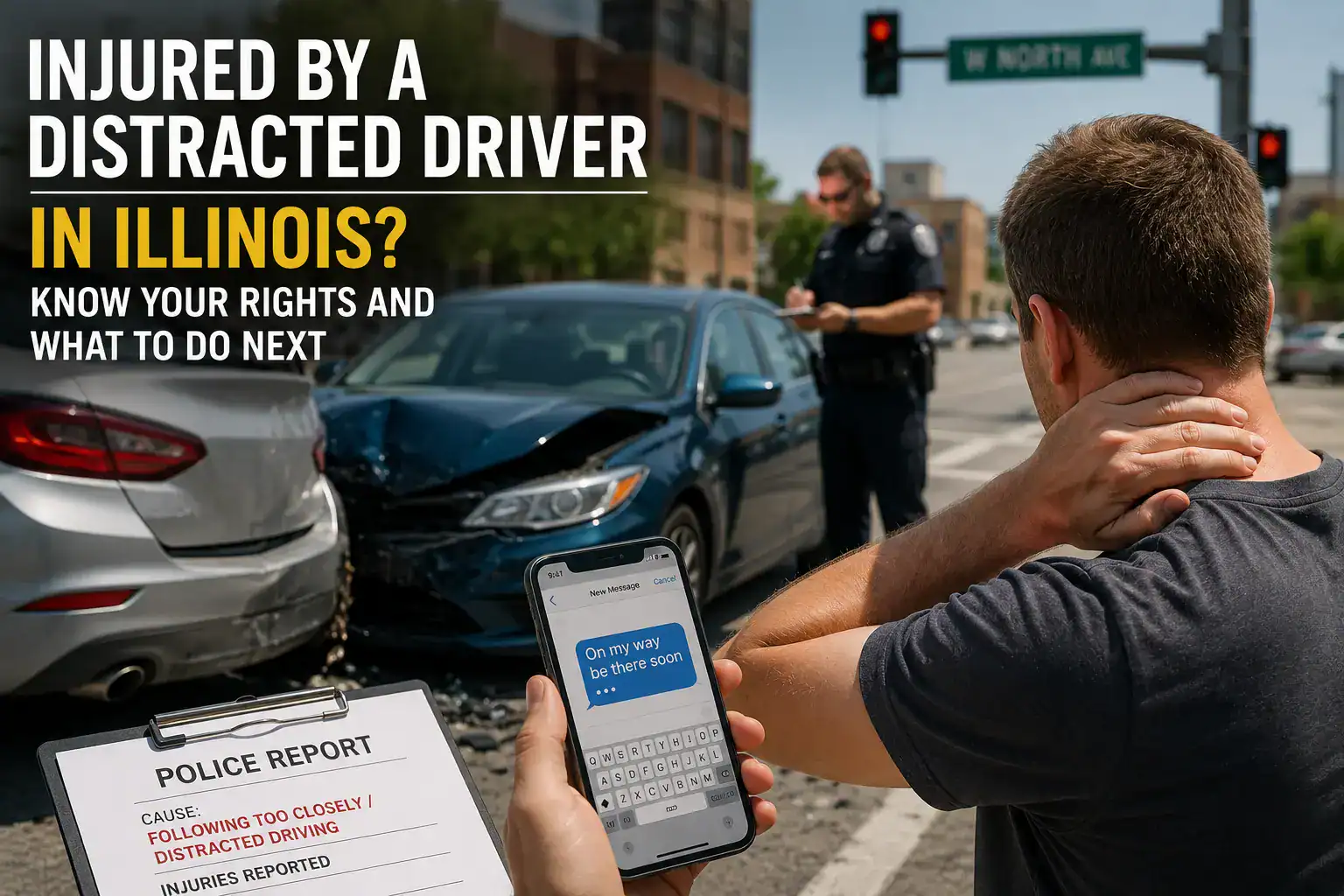
If you were injured by a distracted driver in Illinois, you may be able to pursue compensation for medical bills, lost wages, future care, pain and suffering, and other crash-related losses. Distracted driving is not limited to texting. It can include scrolling, talking on a handheld phone, adjusting a GPS, eating, reaching for an object, or anything else that pulls a driver’s eyes, hands, or attention away from the road.
The challenge is proof. Insurance companies may admit a crash happened but deny that distraction caused it, blame you for part of the collision, or pressure you to settle before your injuries are fully diagnosed.
This guide explains what counts as distracted driving, what evidence can prove it, what damages may be available, and what steps can protect your Illinois injury claim before the insurer controls the story.
Key Takeaways
- Distracted driving can support an Illinois personal injury claim. If another driver’s inattention caused the crash, you may pursue compensation through an insurance claim or lawsuit.
- Video, witnesses, phone records, and police reports matter. The strongest distracted-driving cases usually combine several forms of proof rather than relying on your word alone.
- NHTSA data makes the risk clear. NHTSA reports that distracted driving claimed 3,208 lives and injured 315,167 people in 2024.
- Illinois fault rules can reduce recovery. If the insurer tries to blame you, comparative fault can reduce compensation, and being more than 50% at fault can bar recovery.
- Do not give a recorded statement too early. An adjuster may ask questions designed to minimize distraction, shift fault, or downplay injuries before evidence is gathered.
What Counts as Distracted Driving in Illinois?
Distracted driving means any activity that diverts attention from safe driving. The National Highway Traffic Safety Administration describes distracted driving as anything that takes attention away from driving, including texting, talking on the phone, eating, drinking, talking with passengers, or adjusting entertainment and navigation systems.
For an Illinois injury claim, the most important question is not only whether the driver was distracted, but whether that distraction caused or contributed to the crash. A driver who looks down at a phone while approaching stopped traffic, drifts while adjusting a GPS, or turns without seeing a pedestrian may be negligent even if no ticket was issued at the scene.
The Three Main Types of Driver Distraction
| Type of distraction | What it means | Common crash example |
| Visual | The driver looks away from the road. | Reading a text before rear-ending a stopped car. |
| Manual | The driver removes one or both hands from the wheel. | Reaching for a phone, drink, bag, or object on the floor. |
| Cognitive | The driver’s mind is not focused on driving. | Continuing through an intersection without noticing stopped traffic. |
Texting is especially dangerous because it can involve all three types at once: eyes off the road, hands off the wheel, and attention off driving. NHTSA explains that reading or sending a text takes a driver’s eyes off the road for about five seconds; at 55 mph, that is like driving the length of an entire football field with eyes closed.
What Happens If You Were Injured by a Distracted Driver in Illinois?
After a distracted-driving crash, the injured person usually starts with an insurance claim against the at-fault driver. If the insurance company refuses to pay fairly, the case may become a personal injury lawsuit. The claim should account for both the crash evidence and the full medical and financial impact of the injuries.
You May Have a Claim Against the At-Fault Driver
Illinois is an at-fault state for car accident claims. That means the driver who caused the crash may be responsible for the harm they caused. If distraction led to the collision, the at-fault driver’s liability insurance may be the first source of recovery.
Comparative Fault Can Affect the Amount Recovered
Illinois uses modified comparative fault. Under 735 ILCS 5/2-1116, an injured person’s damages may be reduced by their share of fault, and recovery can be barred if they are more than 50% at fault. That is why insurers often try to argue that the injured person stopped suddenly, changed lanes, failed to brake, or shared blame even when distraction is the real cause.
A Ticket Helps, But It Is Not Required
A citation for handheld device use, failure to reduce speed, improper lane usage, or disobeying a traffic signal can help prove negligence. But a ticket is not required to bring a civil claim. Many distracted drivers are not cited because the officer did not witness the phone use, the driver denies it, or the evidence is discovered later through records or witnesses.
How Do You Prove the Other Driver Was Distracted?
The best distracted-driving claims are built with layered evidence. One piece of proof may help; several pieces together can make the claim much harder for an insurer to deny.
| Evidence | How it can help |
| Police report | Documents driver statements, citations, crash location, roadway conditions, and officer observations. |
| Witness statements | Can confirm the driver was looking down, holding a phone, drifting, speeding, or failing to brake. |
| Dashcam or traffic video | Can show lane position, braking, traffic signals, speed cues, and the moments before impact. |
| Business surveillance footage | May capture the crash from nearby gas stations, stores, parking lots, or apartment buildings. |
| Cellphone records | Can show calls, text timing, or data activity near the time of the crash, usually through subpoena. |
| Vehicle damage patterns | Can support the crash sequence when the driver denies what happened. |
| Event data and telematics | In some cases, vehicle data may show braking, speed, steering, or impact timing. |
Phone Records and Subpoenas
Cellphone records can be powerful, but they are not usually handed over voluntarily. An attorney may need to use a subpoena during litigation to obtain call logs, text timing, or data-use records. The goal is not always to read the content of messages; often, the key issue is whether the phone was active seconds before impact.
Video Evidence Can Change the Claim Fast
Dashcam footage, traffic camera footage, and business surveillance can make a disputed crash much clearer. For example, video may show that the driver never braked before a rear-end crash, drifted out of their lane, entered an intersection late, or looked down moments before impact. This type of evidence also helps protect against false claims that you caused the collision.
Admissions at the Scene Matter
Sometimes the driver admits the truth right after the crash: “I was looking at my phone,” “I did not see you,” or “I looked down for a second.” Write down the exact words as soon as possible. If a witness heard the statement, get their contact information. A later denial becomes weaker when there is a contemporaneous note or witness confirming the admission.
Common Distracted-Driving Crash Scenarios in Illinois
Distracted driving can cause many types of collisions. These examples help explain how distraction becomes evidence in an injury claim.
- Rear-end crash at a red light or stop sign. A driver looking at a phone may fail to notice stopped traffic until it is too late. These crashes often cause neck injuries, back injuries, concussions, shoulder injuries, and aggravation of prior conditions.
- Intersection crash. A distracted driver may run a red light, roll through a stop sign, fail to yield while turning left, or miss a pedestrian in a crosswalk.
- Lane-drift or sideswipe crash. A driver adjusting navigation or reaching for something may drift into the next lane and hit another vehicle.
- Highway or expressway crash. At higher speeds, even a few seconds of inattention can create severe impact forces, multi-vehicle collisions, or chain-reaction crashes.
- Pedestrian or bicycle crash. A distracted driver may miss a cyclist, pedestrian, scooter rider, or person entering a crosswalk, often causing more serious injuries because the victim has little protection.
What Compensation Can You Recover After a Distracted-Driving Crash?
A distracted-driving injury claim should include every category of loss supported by the evidence. The value depends on injury severity, treatment duration, permanency, fault proof, insurance coverage, wage loss, and how the crash affects daily life.
- Medical expenses. Emergency care, ambulance bills, hospital treatment, imaging, surgery, prescriptions, physical therapy, injections, specialist visits, and future medical care.
- Lost wages. Time missed from work for recovery, appointments, physical restrictions, or inability to perform job duties.
- Reduced earning capacity. Future income loss if your injuries prevent you from returning to the same work, hours, or pay level.
- Pain and suffering. Physical pain, discomfort, sleep disruption, activity limits, and the effect of injuries on normal life.
- Emotional distress. Anxiety, fear of driving, depression, PTSD symptoms, or trauma after the crash when supported by documentation.
- Property damage. Vehicle repair or replacement, towing, storage, rental car costs, and damaged personal property.
Punitive Damages Are Possible, But Not Automatic
Punitive damages are designed to punish especially reckless conduct, but they are not awarded in every distracted-driving case. A lawyer would need to evaluate whether the facts support a punitive damages request, such as repeated dangerous conduct, egregious phone use, impaired driving combined with distraction, or other extreme behavior.
What If the Distracted Driver Does Not Have Enough Insurance?
Serious injuries can quickly exceed minimum insurance limits. A single ER visit, ambulance transport, MRI, physical therapy course, or surgical recommendation can consume a modest policy before wage loss and pain and suffering are even discussed.
Illinois requires vehicles with valid registration to comply with the state’s mandatory insurance law. The Illinois Secretary of State explains that insurance verification is handled through an electronic liability insurance verification process. See the Illinois Secretary of State mandatory insurance page for general information about enforcement.
If the distracted driver has low limits or no insurance, your own uninsured or underinsured motorist coverage may become important. Employer coverage may also matter if the distracted driver was working at the time, such as a delivery driver, rideshare driver, salesperson, truck driver, or employee running a work errand.
How Insurance Companies Fight Distracted-Driving Claims
Insurance companies often know distracted driving is dangerous, but they still look for reasons to reduce payouts. Common defenses include:
- “There is no proof the driver was on the phone.”
- “The injured person stopped too suddenly.”
- “The injuries are not related to this crash.”
- “The vehicle damage is too minor for serious injury.”
- “There was a delay in medical treatment.”
- “The claimant had a preexisting condition.”
- “The driver was using GPS or hands-free technology, not texting.”
These defenses are common, but they can be answered with records, witnesses, crash analysis, consistent medical care, and careful claim presentation. The earlier evidence is preserved, the harder it is for the insurer to rewrite the crash.
What Should You Do Immediately After Being Hit by a Distracted Driver?
- Call 911 and report the crash. An official police report can preserve important details and statements.
- Get medical care. Adrenaline can hide pain, and symptoms from concussions, whiplash, and soft-tissue injuries may appear later.
- Tell the officer what you observed. If you saw the driver looking down, holding a phone, or failing to brake, say so clearly.
- Take photos and video. Capture vehicle damage, plate numbers, road signs, traffic signals, skid marks, debris, weather, and the full scene.
- Identify witnesses and cameras. Ask for witness contact information and note nearby businesses, homes, traffic cameras, or dashcams.
- Do not apologize or guess. Even a polite “I’m sorry” can be twisted into an admission.
- Avoid recorded statements. Speak with a lawyer before giving the at-fault driver’s insurer a recorded statement.
- Preserve all evidence. Save medical bills, repair estimates, missed-work proof, photos, messages, and claim correspondence.
How Long Do You Have to File a Distracted-Driving Injury Claim in Illinois?
Most Illinois personal injury lawsuits must be filed within two years from the date the claim accrues under 735 ILCS 5/13-202. However, waiting is risky even when the deadline sounds far away.
Phone records, traffic video, business surveillance footage, dashcam files, witness memories, and vehicle data can disappear quickly. Some surveillance systems overwrite footage within days or weeks. Witnesses may move, forget details, or become harder to reach. Starting early gives your attorney a better chance to preserve evidence before the insurer can argue fault is unclear.
Can You Still Recover If the Distracted Driver Was Not Cited?
Yes. A citation helps, but it is not required. Civil injury claims are different from traffic tickets or criminal charges. In a civil claim, the question is usually whether the evidence shows the other driver was negligent and caused your injuries.
A distracted driver may avoid a ticket because the officer did not personally see the phone use, the driver denied it, or the evidence was not available at the scene. Later evidence, such as phone records, video, witness statements, or deposition testimony, can still prove the case.
How Much Is a Distracted-Driving Injury Case Worth?
There is no one-size-fits-all number. Case value depends on liability proof, insurance coverage, injury severity, medical treatment, future care, wage loss, disability, pain and suffering, and whether the crash caused permanent changes to your life.
For example, a short-treatment soft-tissue case with no missed work is very different from a distracted-driving crash that causes a herniated disc, fracture, surgery, traumatic brain injury, or long-term work restriction. A strong case valuation should look beyond current bills and consider future medical treatment, lost earning ability, and the real daily impact of the injury.
Injured by a Distracted Driver in Illinois? Contact Eliasik Law
If a distracted driver caused your crash, do not let the insurance company decide the value of your claim before the evidence is gathered. Contact The Law Offices of John S. Eliasik for a free case evaluation. The firm can help preserve evidence, deal with adjusters, review insurance coverage, and pursue the compensation available under Illinois law.
FAQs
What happens if you were injured by a distracted driver in Illinois?
You may file a personal injury claim against the at-fault driver and seek compensation for medical bills, lost wages, pain and suffering, property damage, and future losses. The strongest claims use evidence such as police reports, witnesses, video, and phone records.
How do you prove a driver was distracted?
Proof may include witness statements, dashcam footage, surveillance video, phone records, police observations, admissions at the scene, and crash patterns. Phone records usually require a subpoena if the driver will not voluntarily provide them.
Can I recover if the distracted driver was not ticketed?
Yes. A ticket helps, but it is not required for a civil injury claim. You can still prove negligence with other evidence, including video, witnesses, phone records, and medical documentation.
What if the distracted driver says I stopped suddenly?
That is a common insurance defense. Photos, vehicle damage, dashcam footage, witness statements, and traffic conditions can show whether the driver failed to keep a proper lookout or failed to brake because they were distracted.
Can I sue if a distracted driver hit me as a pedestrian or cyclist?
Yes. Distracted drivers may be liable for injuries to drivers, passengers, pedestrians, bicyclists, and motorcyclists. These cases can involve serious injuries because pedestrians and cyclists have little physical protection.
What if the distracted driver had no insurance?
Your own uninsured motorist coverage may apply, depending on your policy. If the driver was working, employer or commercial coverage may also be available. A lawyer can investigate all possible sources of recovery.
Can I recover compensation for emotional distress?
Yes, emotional distress may be part of non-economic damages when it is connected to the crash and supported by evidence. Anxiety, fear of driving, depression, PTSD symptoms, and sleep problems should be documented with medical or mental health providers.
What if I had a preexisting injury before the crash?
A preexisting condition does not automatically defeat your claim. If the distracted-driving crash aggravated or worsened a prior condition, you may seek compensation for the aggravation with proper medical documentation.
Should I give the insurance company a recorded statement?
Be careful. You are generally not required to give a recorded statement to the other driver’s insurer before getting legal advice. Adjusters may use recorded answers to dispute fault, injuries, or damages.
How long do I have to file a lawsuit after a distracted-driving crash in Illinois?
Most Illinois personal injury lawsuits must be filed within two years, but evidence can disappear much sooner. It is best to act quickly to preserve phone records, video footage, witness information, and medical documentation.
Disclaimer: This article is provided by Eliasik Law for general informational purposes only and does not constitute legal advice. Reading this content does not create an attorney-client relationship. Laws, fees, regulations, and court decisions referenced may change. For advice on your specific situation, please contact Eliasik Law directly to schedule a consultation.