
Table of Contents
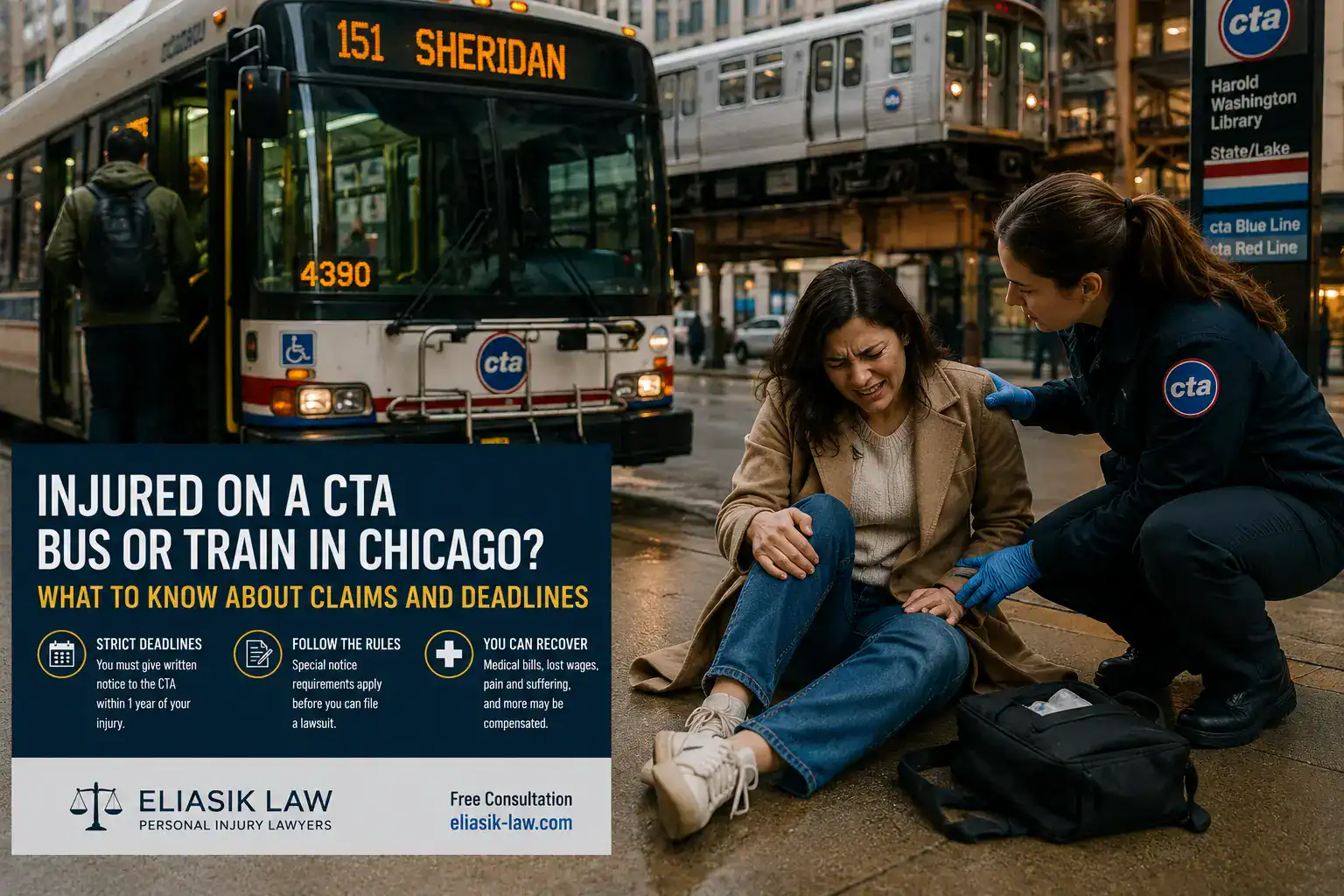
If you were injured on a CTA bus, train, station platform, stairway, escalator, or other CTA property in Chicago, you may have a personal injury claim if negligence caused your injury. The most important deadline is short: under the Metropolitan Transit Authority Act, a personal injury lawsuit against the Chicago Transit Authority must be filed within one year from the date the cause of action accrued. That is much shorter than the usual two-year Illinois personal injury deadline.
This means you should not wait for the CTA, an insurance adjuster, a medical provider, or a third party to “sort things out.” Evidence can disappear quickly, surveillance video may be overwritten, witnesses may become difficult to find, and the one-year clock can run before many injured riders realize their claim is different from a regular car accident case.
Key Takeaways for CTA Injury Claims in Chicago
- CTA cases move faster than ordinary Illinois injury claims. The general Illinois personal injury statute usually gives two years, but CTA injury lawsuits are governed by a shorter one-year rule.
- A CTA incident report is helpful, but it is not the same as filing a lawsuit. Reporting the injury to a driver, conductor, station attendant, or customer service representative creates a record, but it does not stop the legal deadline from running.
- Video evidence may be critical. Buses, trains, stations, platforms, nearby businesses, and bystanders may have useful footage, but it must be requested and preserved quickly.
- Liability may involve more than the CTA. A private contractor, security company, negligent driver, equipment manufacturer, property owner, or another passenger may also share fault.
- Medical documentation matters from day one. Treatment gaps give the CTA and its defense team room to argue your injury was minor, unrelated, or caused by something else.
Why CTA Injury Claims Are Different From Regular Accident Claims
A CTA injury case is not handled the same way as a typical car accident claim against a private driver. The CTA is a public transportation authority created by Illinois law. The Metropolitan Transit Authority Act states that the Authority may sue and be sued in its corporate name, which means injury claims can be brought against it when the facts and law support liability.
But because the CTA is a public entity, cases against it involve shorter deadlines, public-record issues, immunity defenses, and defense lawyers who know exactly how to use procedural mistakes against injured riders. A regular Illinois car accident case may mainly involve an insurance adjuster. A CTA case may involve incident reports, station video, bus or train operator records, maintenance logs, police reports, medical records, witness statements, and legal questions about government immunity.
The scale of the system is also important. CTA reported 309.2 million total bus and rail rides in calendar year 2024, including 181.7 million bus rides and 127.5 million rail rides. Even a small percentage of serious incidents can involve many riders, crowded platforms, high-use bus routes, and complex evidence trails.
The One-Year CTA Injury Deadline You Cannot Miss
The most important deadline for an injured CTA rider is the one-year lawsuit deadline. Section 41 of the Metropolitan Transit Authority Act says that no civil action may be commenced against the Authority for personal injury unless it is commenced within one year from the date the cause of action accrued. The Local Governmental and Governmental Employees Tort Immunity Act also contains a one-year limitation for civil actions against local entities and employees for injury claims.
That deadline is easy to misunderstand because most Illinois personal injury claims are subject to the two-year personal injury statute of limitations. CTA cases are different. If an injured rider assumes they have two years and waits too long, they may lose the right to sue even if the CTA was clearly at fault.
Important practical point: submitting a complaint, reporting the incident, calling CTA customer service, waiting for medical bills, or discussing the claim with an adjuster does not automatically extend the one-year lawsuit deadline. A lawyer should review the facts as early as possible so the correct deadline is protected.
What Counts as a CTA Bus or Train Injury Claim?
A CTA injury claim may arise from many different situations. The most common examples include:
- A bus driver slamming the brakes, taking a turn too sharply, or accelerating before passengers are safely seated or stable.
- A CTA train door closing on a passenger, malfunctioning, or failing to detect someone entering or exiting.
- A slip and fall on a wet, icy, broken, uneven, or poorly maintained platform, stairway, escalator, elevator, or station floor.
- A collision involving a CTA bus, train, maintenance vehicle, or another vehicle.
- An injury caused by broken handrails, defective seating, unsafe boarding conditions, overcrowding, inadequate lighting, or malfunctioning equipment.
- An assault or security incident where the facts suggest CTA personnel or contractors failed to respond to a known or foreseeable danger.
Not every injury on CTA property automatically creates a winning case. The key question is whether negligence, unsafe conditions, lack of proper maintenance, operator error, inadequate security, or another legally responsible cause contributed to the injury.
What to Do Immediately After You Are Injured on the CTA
The first few hours after a CTA accident can shape the entire case. Here is the practical checklist an injured rider should follow when possible:
- Get medical help immediately. Call 911 if the injury is serious. If you leave the scene, go to urgent care, the ER, or your doctor as soon as possible.
- Report the incident to CTA personnel. Tell the bus operator, train operator, station attendant, security personnel, or CTA customer service what happened. Ask whether an incident report will be created.
- Write down the bus number, train line, station, route, and exact time. Small details can help identify video, operator logs, dispatch records, and witnesses.
- Photograph the scene. Take pictures of the wet floor, broken step, defective door, missing warning sign, damaged bus, platform area, train car, lighting, weather conditions, and any visible injuries.
- Get witness information. Other riders may leave quickly. Names, phone numbers, and short witness notes can become powerful evidence later.
- Preserve your Ventra, receipt, phone records, and trip details. These may help confirm you were on the bus, train, or platform at the time of the incident.
- Do not give recorded statements or sign releases without legal advice. A short statement can be used later to argue that you were not badly hurt or that the CTA did nothing wrong.
What Evidence Can Strengthen a CTA Injury Claim?
Strong CTA claims are built on specific evidence, not general statements like “the bus stopped too fast” or “the platform was unsafe.” The strongest evidence often includes:
- Surveillance video: CTA buses, rail cars, stations, platforms, elevators, escalators, and nearby businesses may have camera footage. A preservation request should be sent quickly because video may not be saved indefinitely.
- Incident reports: Reports created by CTA personnel, police, security, EMS, or station staff can confirm the date, time, location, and initial facts.
- Operator and dispatch records: These may show route timing, sudden stops, communication with supervisors, complaints, mechanical issues, or prior problems.
- Maintenance and inspection records: If a door, escalator, handrail, stairway, bus seat, train car, or platform condition caused the injury, maintenance records can show whether the CTA knew or should have known about the hazard.
- Witness testimony: Other riders may describe the sudden stop, slick floor, broken equipment, security issue, or operator conduct.
- Medical records: Emergency treatment, diagnostic imaging, therapy notes, prescriptions, specialist reports, and work restrictions connect the injury to the incident.
- Wage and employment records: Pay stubs, W-2s, employer letters, missed-shift records, and disability notes help prove lost income.
A lawyer can also use public-record tools such as Illinois FOIA requests to seek public agency records, but FOIA is not a substitute for litigation discovery or subpoena power. Some records may be exempt, delayed, redacted, or unavailable without a lawsuit.
Common CTA Injury Defenses You Should Expect
The CTA and its defense team may not simply accept responsibility. Common defense arguments include:
- “The rider did not report the injury right away.”
- “There is no video showing the incident.”
- “The bus stop was normal, not sudden or negligent.”
- “The passenger was not holding a pole or handrail.”
- “The floor was not wet long enough for CTA employees to know about it.”
- “The injury was pre-existing or unrelated.”
- “A third party, not the CTA, caused the incident.”
- “The lawsuit was filed too late.”
This is why documentation matters. If your medical records, photos, witness information, and timeline are weak, the defense has more room to minimize the claim. If the evidence is organized early, the case becomes much harder to dismiss or lowball.
Who May Be Liable for a CTA Bus or Train Injury?
The CTA may be the main defendant, but it is not always the only potentially responsible party. Depending on the facts, liability may involve:
- The CTA, if unsafe operations, poor maintenance, operator negligence, station hazards, or inadequate response caused the injury.
- A CTA bus or train operator, if operator conduct contributed to the incident.
- A maintenance contractor, cleaning contractor, escalator/elevator company, or construction contractor.
- A private security company or third-party vendor working on CTA property.
- Another driver, if a crash involved a CTA bus and a private vehicle.
- Another passenger or individual, if an assault or dangerous act caused the injury.
Identifying every responsible party matters because CTA-related injuries can involve serious medical bills, lost wages, long-term limitations, and multiple insurance or liability sources. A case that looks like a “CTA-only” claim at first may also involve a private company or individual whose negligence contributed to the injury.
What Damages Can You Recover After a CTA Injury?
If negligence caused your CTA injury, compensation may include both economic and non-economic damages. Economic damages are the financial losses you can document. Non-economic damages cover the human impact of the injury.
- Medical expenses: ER care, ambulance bills, surgery, imaging, medications, physical therapy, injections, follow-up visits, and future medical care.
- Lost wages: Missed shifts, reduced hours, lost overtime, lost bonuses, used PTO, and time away from work for treatment.
- Loss of earning capacity: Reduced ability to work if the injury limits your job duties, hours, or career path.
- Pain and suffering: Physical pain, sleep disruption, mobility problems, anxiety, depression, loss of enjoyment of life, and daily limitations.
- Permanent injury or disability: Long-term impairment, scarring, traumatic brain injury, spinal injuries, nerve damage, or permanent work restrictions.
- Out-of-pocket losses: Transportation to appointments, medical devices, home help, replacement property, and other injury-related costs.
The value of a CTA injury case depends on liability, the strength of the evidence, the seriousness of the injury, the length of treatment, whether future care is needed, and how the injury affects work and daily life.
How Comparative Fault Can Affect a CTA Claim
Illinois uses modified comparative negligence. Under 735 ILCS 5/2-1116, an injured person can recover damages if they are not more than 50% at fault, but the recovery is reduced by their percentage of fault. If a judge or jury finds the injured person more than 50% responsible, recovery is barred.
In a CTA case, comparative fault arguments may focus on whether the passenger was holding a handrail, rushing through closing doors, ignoring warnings, standing in an unsafe area, intoxicated, distracted by a phone, or acting aggressively. These arguments do not automatically defeat a claim, but they must be anticipated and answered with evidence.
What If You Were Hurt by a Third Party on CTA Property?
Some CTA injury cases involve assaults, fights, robberies, harassment, or other passenger misconduct. In those cases, the claim may turn on whether the harm was foreseeable and whether the CTA or its contractors failed to take reasonable steps after becoming aware of a danger.
For example, a case may be stronger if there were prior complaints, ongoing threats, a known security issue, ignored emergency calls, broken emergency equipment, lack of response from personnel, or surveillance showing a delayed response. A case may be harder if the assault was sudden, unpredictable, and there was no reasonable opportunity for CTA personnel to intervene.
A third-party assault case should be reviewed quickly because multiple deadlines and evidence sources may apply. Claims against the CTA may follow the one-year public-entity deadline, while claims against private parties may involve different Illinois deadlines.
How Long Does a CTA Injury Claim Take?
The timeline depends on the severity of the injury, how quickly evidence is preserved, whether liability is disputed, and whether a lawsuit must be filed. Some claims may resolve after medical treatment stabilizes and the evidence is clear. More serious or contested cases can take longer because they may require litigation, subpoenas, depositions, expert review, medical opinions, and trial preparation.
One thing should not be delayed: legal review. Waiting until treatment is finished can be dangerous in a CTA case because the one-year lawsuit deadline may arrive before the full medical picture is known. A lawyer can protect the deadline while the medical claim value is still developing.
Mistakes That Can Hurt a CTA Injury Claim
Avoid these common mistakes after a CTA bus, train, or station injury:
- Waiting weeks or months before seeking medical care.
- Failing to report the injury to CTA personnel.
- Not writing down the bus number, route, train line, station, direction of travel, or time.
- Assuming the CTA will automatically preserve video.
- Posting about the accident, injuries, or claim on social media.
- Giving a recorded statement without preparation.
- Accepting a quick settlement before knowing the full medical impact.
- Assuming the general two-year Illinois deadline applies.
- Waiting until the one-year CTA lawsuit deadline is almost over.
Get Help With a CTA Bus or Train Injury Claim in Chicago
CTA injury claims are deadline-sensitive and evidence-heavy. If you were hurt on a CTA bus, train, platform, stairway, escalator, elevator, or station property, do not wait for the CTA to decide whether your claim matters. Contact The Law Offices of John S. Eliasik for a free case evaluation and find out what steps may protect your right to compensation.
FAQs
How long do I have to sue the CTA after a bus or train injury in Chicago?
In most personal-injury cases against the CTA, the key deadline is one year from the date the cause of action accrued. That is shorter than the general two-year Illinois personal injury deadline, so you should speak with a lawyer as soon as possible.
Is reporting the injury to the CTA the same as filing a lawsuit?
No. Reporting the incident may create an important record, but it does not automatically file your case in court or stop the statute of limitations from running. A lawsuit must be filed before the deadline if the claim is not resolved.
Can I sue if I slipped and fell on a CTA platform or station floor?
Yes, if you can prove an unsafe condition and legal responsibility. Useful evidence may include photos, witness statements, incident reports, cleaning records, maintenance logs, weather conditions, and surveillance video.
Can I recover if a CTA bus stopped suddenly and I fell?
Possibly. A sudden stop alone does not always prove negligence, but a claim may be stronger if the operator was speeding, following too closely, braking unnecessarily, violating safety rules, or if video and witnesses support your account.
What if a CTA train door closed on me?
A door injury may involve operator error, equipment malfunction, sensor issues, crowding, or unsafe boarding conditions. You should report the incident immediately, seek medical care, and request that any video or maintenance records be preserved.
Does CTA surveillance video get saved automatically?
You should not assume it will be available later. Video may be overwritten or difficult to locate unless it is requested quickly and specifically. Write down the date, time, station, train line, bus number, and route as soon as possible.
Can I still recover if I was partly at fault?
Yes, if you were not more than 50% at fault under Illinois modified comparative negligence rules. Your compensation may be reduced by your percentage of fault, so evidence is important when the CTA argues that you contributed to the injury.
What damages can I claim after a CTA injury?
You may be able to claim medical bills, future treatment, lost wages, reduced earning capacity, pain and suffering, emotional distress, permanent limitations, and out-of-pocket expenses if the evidence supports those damages.
What if another passenger assaulted me on CTA property?
You may have a claim against the person who assaulted you and, in some cases, against the CTA or a security contractor if there was a foreseeable danger and a failure to respond reasonably. These cases depend heavily on facts, prior warnings, video, and security records.
Should I wait until I finish medical treatment before calling a lawyer?
No. Treatment may take months, but CTA deadlines and evidence preservation issues start immediately. A lawyer can protect the deadline and evidence while your medical condition is still developing.
Disclaimer: This article is provided by Eliasik Law for general informational purposes only and does not constitute legal advice. Reading this content does not create an attorney-client relationship. Laws, fees, regulations, and court decisions referenced may change. For advice on your specific situation, please contact Eliasik Law directly to schedule a consultation.