
Table of Contents
If another driver is blaming you for a crash, camera footage may be the evidence that changes the claim. Traffic camera footage, business surveillance footage, doorbell video, dashcam footage, police bodycam video, or nearby security recordings can help show who had the red light, who changed lanes, who braked, who was speeding, and what happened in the seconds before impact.
Yes, you can use traffic camera or business surveillance footage after an Illinois car accident, but speed matters. Many systems overwrite footage within days or weeks, and some public traffic cameras are live-monitoring cameras that may not record at all. The safest move is to identify cameras immediately, request preservation in writing, and avoid giving the insurance company a chance to settle the claim before the best evidence is secured.
This guide explains what footage may exist, who owns it, how to request it, how quickly it can disappear, and how The Law Offices of John S. Eliasik can help preserve video evidence before an insurer controls the story.
Key Takeaways
- Traffic camera and business surveillance footage can help prove fault after an Illinois car accident, especially when the other driver denies responsibility.
- Not every traffic camera records. Some are live feeds for traffic monitoring, while red-light or speed cameras may only save images or short clips when a violation is triggered.
- Business security cameras, gas station cameras, doorbell cameras, dashcams, police body cameras, and tow-yard footage can all become useful evidence.
- Footage may be overwritten quickly, sometimes within days. A preservation letter should be sent as soon as possible.
- Video evidence should be preserved in its original form, with the timestamp, file data, and chain of custody protected.
- Before giving video to the other driver’s insurer, have an attorney review it because footage can help or hurt depending on what it shows.
What Types of Camera Footage May Exist After an Illinois Car Accident?
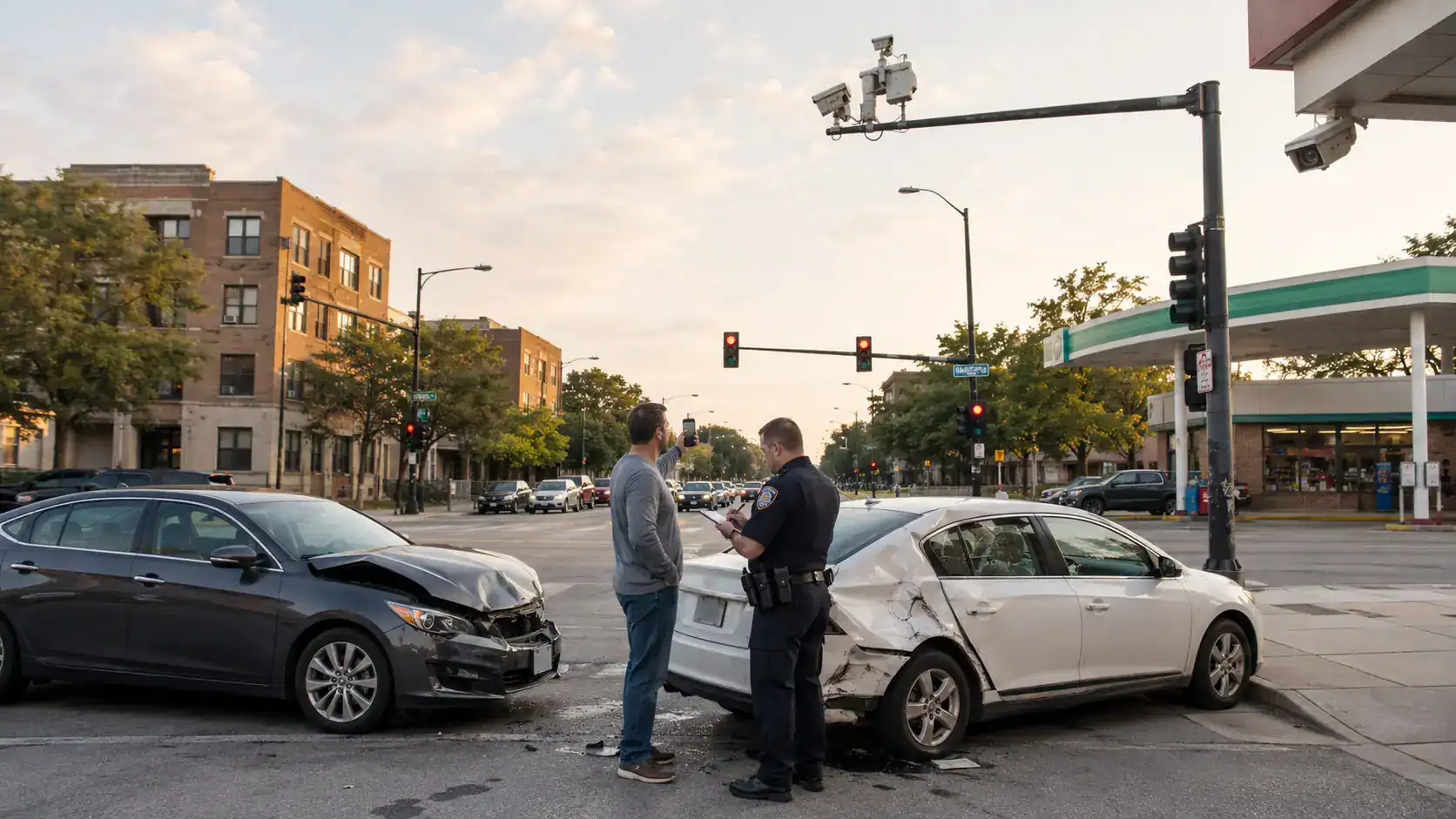
A crash in Chicago, the suburbs, or another busy Illinois roadway may be captured by more than one camera. The most useful source is not always the obvious one. A traffic signal camera may miss the angle, while a gas station camera, apartment security camera, delivery truck dashcam, or nearby doorbell camera may show the entire sequence.
Traffic Cameras, Red-Light Cameras, and Speed Cameras
Traffic cameras are often used by transportation agencies to monitor congestion, roadway conditions, and major intersections. Some record, but others are live-only. Red-light and speed enforcement cameras are different because they may save images or short clips when a violation is detected.
For a car accident claim, the important question is not just whether a camera was present. The real questions are whether it recorded, whether the footage was saved, who controls the file, and whether the view actually shows the crash.
Business Surveillance Cameras
Businesses often provide the best footage. Gas stations, restaurants, convenience stores, banks, warehouses, auto shops, apartment buildings, parking garages, and retail stores may have cameras facing driveways, parking lots, sidewalks, and public roads.
In a disputed crash, a nearby business camera may show the other driver entering the intersection, failing to yield, turning without signaling, or leaving the scene. Even if the camera does not show the impact, it may show vehicle positions seconds before or after the collision.
Residential Cameras, Dashcams, and Police Video
Doorbell cameras and home security cameras are now common in residential neighborhoods. A camera facing the street may capture a collision, a hit-and-run vehicle, or the sound and timing of the crash. Other drivers may also have dashcam footage. If police respond, bodycam or squad-car video may capture statements, vehicle positions, road conditions, and the immediate aftermath.
Can Traffic Camera or Surveillance Footage Be Used as Evidence in Illinois?
Yes. Video footage may be used in Illinois car accident claims if it is relevant, authentic, and connected to the crash. In practical terms, that means someone must be able to explain where the video came from, when it was recorded, who preserved it, and whether it has been altered.
Video Evidence Must Be Authenticated
Courts and insurers usually want a clean chain of custody. A business manager may need to confirm that the video came from the store’s security system. A public agency may need to produce the file through a formal records request. A dashcam owner may need to confirm that the video is from the date, time, and vehicle involved in the crash.
Do not trim, compress, edit, add captions to, or repost the video. Keep the original file and make a separate copy. If the file metadata is questioned later, the original version may matter.
What Video Can Prove
Camera footage can help prove speed, traffic-light phase, lane position, following distance, turn signals, brake lights, weather, road conditions, vehicle damage, and the sequence of impact. It can also identify witnesses, show a hit-and-run vehicle, or contradict a driver who changes their story after speaking with the insurance company.
Partial Footage Can Still Help
The video does not always need to show the exact moment of impact. Footage from the seconds before the crash can show who had the right-of-way. Footage after the crash can show where the vehicles stopped, what the other driver said, whether they appeared distracted or impaired, and whether they tried to leave the scene.
Why You Need to Act Fast Before the Footage Disappears
The biggest problem with traffic camera and business surveillance footage is that it may disappear before an injured person knows to ask for it. Many systems automatically overwrite older footage to save storage space. Some cameras do not save footage unless a trigger occurs. Some businesses will not release footage voluntarily without a formal request.
Common Retention Windows Are Short
There is no universal Illinois rule requiring private businesses to keep ordinary surveillance footage for a set number of days after a crash. A small business may keep footage for only several days. A larger retailer may keep it longer. Doorbell camera footage may depend on the owner’s subscription and settings. Public traffic systems may have their own retention rules, and some feeds may not record at all.
Because retention varies so much, the safest assumption is that the footage could be overwritten quickly. Waiting even two or three weeks can be too long in many cases.
Preservation Letters Can Make a Difference
A preservation letter tells a business, property owner, public agency, or other potential evidence holder not to delete footage connected to the crash. The letter should identify the accident date, approximate time, location, camera direction, vehicles involved, and why the footage matters.
A preservation letter does not guarantee cooperation, but it creates a written record that the footage was requested before it was deleted. If the video is destroyed after notice, that can become important later.
How to Request Traffic Camera Footage After an Illinois Car Accident
If a public traffic camera may have recorded your accident, the request usually goes to the government agency that controls the camera. The correct agency may be the Illinois Department of Transportation, the City of Chicago, a suburb, a county transportation department, or a police department.
Identify the Correct Public Agency
Start with the exact location: intersection, cross streets, highway, ramp, mile marker, direction of travel, and the nearest business or landmark. Then identify whether the road is city, county, state, or private. Asking the wrong agency can waste critical time while footage is being overwritten.
Use FOIA for Public Records
In Illinois, public camera footage held by a public body may need to be requested through the Illinois Freedom of Information Act. A strong request should include the crash date, exact time window, location, camera direction, case or crash report number, and a request that the agency preserve the footage while the request is pending.
FOIA requests should be precise. For example: “Please preserve and produce any traffic camera, red-light camera, speed camera, roadway camera, or police camera footage showing the intersection of West Madison Street and North Ashland Avenue from 3:35 p.m. to 3:50 p.m. on July 8, 2026.”
Ask for Logs, Not Just Video
If an agency says no footage exists, ask whether the camera was live-only, whether footage was overwritten, whether a red-light event was triggered, whether a vendor controls the system, and whether system logs show recording status. Sometimes the answer “we do not have footage” means the request went to the wrong office, not that the evidence never existed.
How to Get Business Surveillance Footage After an Illinois Car Accident
Business surveillance footage is private property. You generally cannot force a business to hand over video simply because you ask at the counter. Some managers will cooperate, but many will require a lawyer’s request, corporate approval, insurance involvement, or a subpoena.
Ask Quickly and Politely
If you are physically able, ask nearby businesses whether they have cameras facing the crash scene. Get the business name, address, manager’s name, and phone number. Do not argue if they refuse to provide footage. The first goal is to identify the source before the footage is deleted.
Send a Written Preservation Request
A law-firm preservation letter usually has more impact than an informal phone call. It should tell the business to preserve footage for a specific date, time, and camera angle. It should also ask the business not to overwrite or delete footage during the claim investigation.
Use a Subpoena When Needed
If the business refuses to release footage voluntarily, a subpoena may be needed after a lawsuit is filed. This is one reason to involve a lawyer early when fault is disputed, injuries are serious, or video may decide the case.
What If the Footage Was Deleted Before You Got It?
If footage was deleted before anyone requested preservation, it may be difficult to recover. But losing one video source does not automatically end the claim. Other evidence may still prove what happened.
Automatic Overwriting Is Common
Many surveillance systems delete old footage automatically. If no one had notice that the video was important, a business may argue that ordinary overwriting was routine and not intentional destruction. That is why early action matters.
Deletion After Notice Is Different
If a business, agency, or other party deletes footage after receiving a preservation request, the issue becomes more serious. Depending on the facts, a court may consider whether evidence was destroyed after the party knew or should have known it was relevant to a legal claim.
Other Evidence Can Still Build the Case
If footage is gone, your case may still rely on police reports, dashcam footage, vehicle damage photos, witness statements, skid marks, debris fields, crash-scene measurements, medical records, phone records, event data recorders, and accident reconstruction analysis.
How Video Evidence Can Prove Fault in an Illinois Car Accident Claim
Video evidence is powerful because it can replace conflicting stories with a timeline. When one driver says they had a green light and the other says the opposite, camera footage may show the signal phase, traffic flow, or vehicle movement that decides the fault dispute.
Red-Light, Stop-Sign, and Failure-to-Yield Crashes
At intersections, video may show whether a driver entered against a red light, rolled through a stop sign, turned left across oncoming traffic, or failed to yield to a pedestrian or bicyclist. These are some of the clearest uses for camera footage.
Lane-Change and Sideswipe Crashes
For lane-change crashes, video can show whether a driver drifted, changed lanes without signaling, merged too closely, or crossed a lane line. This matters because sideswipe crashes often turn into “your word against theirs” disputes unless there is objective proof.
Distracted Driving Evidence
Camera footage may also support a distracted-driving theory. NHTSA reports that distracted driving claimed 3,208 lives and injured 315,167 people in 2024, and explains that sending or reading a text at 55 mph takes a driver’s eyes off the road for about the length of a football field. If footage shows a driver looking down before impact, drifting, or failing to brake, it can help connect distraction to the crash.
Hit-and-Run and Uninsured Motorist Claims
If the other driver fled, video may identify the vehicle, license plate, color, make, model, direction of travel, and time of departure. Even if the driver is never found, the video can help support an uninsured motorist claim by showing that another vehicle caused the crash.
Examples of How Surveillance Footage Can Change a Claim
Examples are not guarantees, but they show why video can be so valuable in an Illinois accident claim.
- Intersection dispute: The other driver claims your client ran the red light. A nearby store camera shows cross-traffic stopped and your lane moving with the green. The insurer can no longer fairly treat fault as “50/50.”
- Parking lot crash: The other driver says both cars backed up at the same time. A grocery store camera shows the other driver backing quickly while your vehicle was stopped. Property-damage and injury liability become clearer.
- Hit-and-run: A doorbell camera captures the fleeing vehicle’s plate and direction of travel. Police can investigate, and your own uninsured motorist carrier has stronger proof that another driver caused the crash.
- Lowball settlement: The insurer offers little because the police report is unclear. Video shows the at-fault driver cutting across two lanes without signaling. The negotiation shifts from fault to damages.
What Should You Do After an Illinois Car Accident to Preserve Video Evidence?
The first 24 to 48 hours can be critical. You may be hurt, stressed, or focused on medical care, but camera footage often disappears faster than medical records or police reports.
At the Scene
- Look for traffic cameras, red-light cameras, storefront cameras, apartment cameras, parking-lot cameras, and doorbell cameras.
- Take photos of the cameras and the direction they face.
- Write down nearby business names, addresses, and phone numbers.
- Ask witnesses whether they have dashcam footage.
- Call police so the crash location, time, and statements are documented.
Within the First Day or Two
- Request the police report or crash report number.
- Save your own dashcam or phone video in its original format.
- Contact businesses near the crash and ask them to preserve footage.
- Have a lawyer send preservation letters to businesses, property owners, police departments, and public agencies.
- Avoid posting crash footage or scene photos on social media.
Before Speaking With the Insurance Company
Do not assume the insurance adjuster will help find video that supports your claim. The other driver’s insurer is not your investigator. If you mention possible footage, they may ask for it, but that does not mean they will search every nearby camera or preserve every source.
Can Camera Footage Hurt Your Illinois Car Accident Claim?
Yes. Video evidence is not automatically good for the injured person. It helps when it supports your version of events. It can hurt if it shows speeding, unsafe lane changes, distraction, sudden braking, road rage, or another fact the insurance company can use against you.
Review the Footage Before Sharing It
Before sending footage to the other driver’s insurer, have an attorney review it. Once the insurer has the file, it can analyze every frame, compare it to your statements, and use anything unfavorable to reduce settlement value.
Audio May Create Separate Problems
Some dashcams and phone recordings include audio. Illinois has strict rules around recording private conversations, and audio may also capture statements that can be misinterpreted. If a file includes audio, do not edit it yourself. Have an attorney review the legal and strategic issues before using it.
Video Does Not Prove Medical Injury by Itself
Footage may prove how the crash happened, but medical records prove the injury. If the video shows a low-speed collision but you have serious symptoms, you need medical documentation, imaging, diagnosis, and treatment records that explain how the crash caused or aggravated your injuries.
Need Help Finding Camera Footage After an Illinois Car Accident?
If you believe traffic camera footage, business surveillance video, doorbell footage, or dashcam evidence may exist, act quickly. Contact The Law Offices of John S. Eliasik for help identifying possible camera sources, sending preservation letters, requesting public records, and using video evidence to strengthen your Illinois car accident claim.
FAQs
Can you use traffic camera footage after an Illinois car accident?
Yes. Traffic camera footage may be used if it exists, is relevant, and can be authenticated. The challenge is getting it before it is overwritten or confirming whether the camera recorded anything at all.
How do I get traffic camera footage after a crash in Illinois?
Identify the agency that controls the camera and submit a precise public records request. Include the date, time, location, camera direction, and crash report number. A lawyer can also send a preservation letter while the request is pending.
Can I get business surveillance footage after an Illinois car accident?
You can ask, but private businesses are not always required to give footage voluntarily. A preservation letter can help prevent deletion, and a subpoena may be needed if the business refuses to release the video.
How long do businesses keep surveillance footage after a crash?
It varies. Some systems overwrite footage within days, while others keep it for weeks or longer. Because there is no universal retention period, request preservation as soon as possible.
What if the traffic camera did not record the actual impact?
Partial footage can still help. Video may show vehicle positions, traffic signals, speed, lane changes, witnesses, or the immediate aftermath. These details can support your version of the crash.
Can surveillance footage prove the other driver was at fault?
Yes, if the footage shows facts such as a red-light violation, unsafe lane change, failure to yield, distraction, or hit-and-run behavior. It can also contradict a driver who changes their story later.
Will the police automatically collect camera footage after an accident?
Usually not for ordinary crashes. Police may collect footage in serious injury, fatal, hit-and-run, or criminal investigations, but injured people should not assume officers preserved every possible video source.
What happens if a business deletes footage after being asked to save it?
If footage is deleted after a proper preservation request, the deletion may become an evidence issue. A lawyer can evaluate whether sanctions, discovery remedies, or a spoliation argument may apply.
Should I give camera footage to the insurance adjuster?
Not before reviewing it with a lawyer. Video can help or hurt depending on what it shows. An attorney can decide when and how to disclose the footage strategically.
Can video footage help if the other driver fled the scene?
Yes. Footage may capture the vehicle, license plate, direction of travel, or identifying details. It may also support an uninsured motorist claim if the driver cannot be found.
Disclaimer: This article is provided by Eliasik Law for general informational purposes only and does not constitute legal advice. Reading this content does not create an attorney-client relationship. Laws, fees, regulations, and court decisions referenced may change. For advice on your specific situation, please contact Eliasik Law directly to schedule a consultation.